Velvet with gold discs (late 1200s or earlier): Art, History and Details
Velvet with gold discs at the Cleveland Museum of Art: late 1200s or earlier, silk, gilt-metal thread; brocaded velvet. Explore the work's context, creator attribution and collection history.
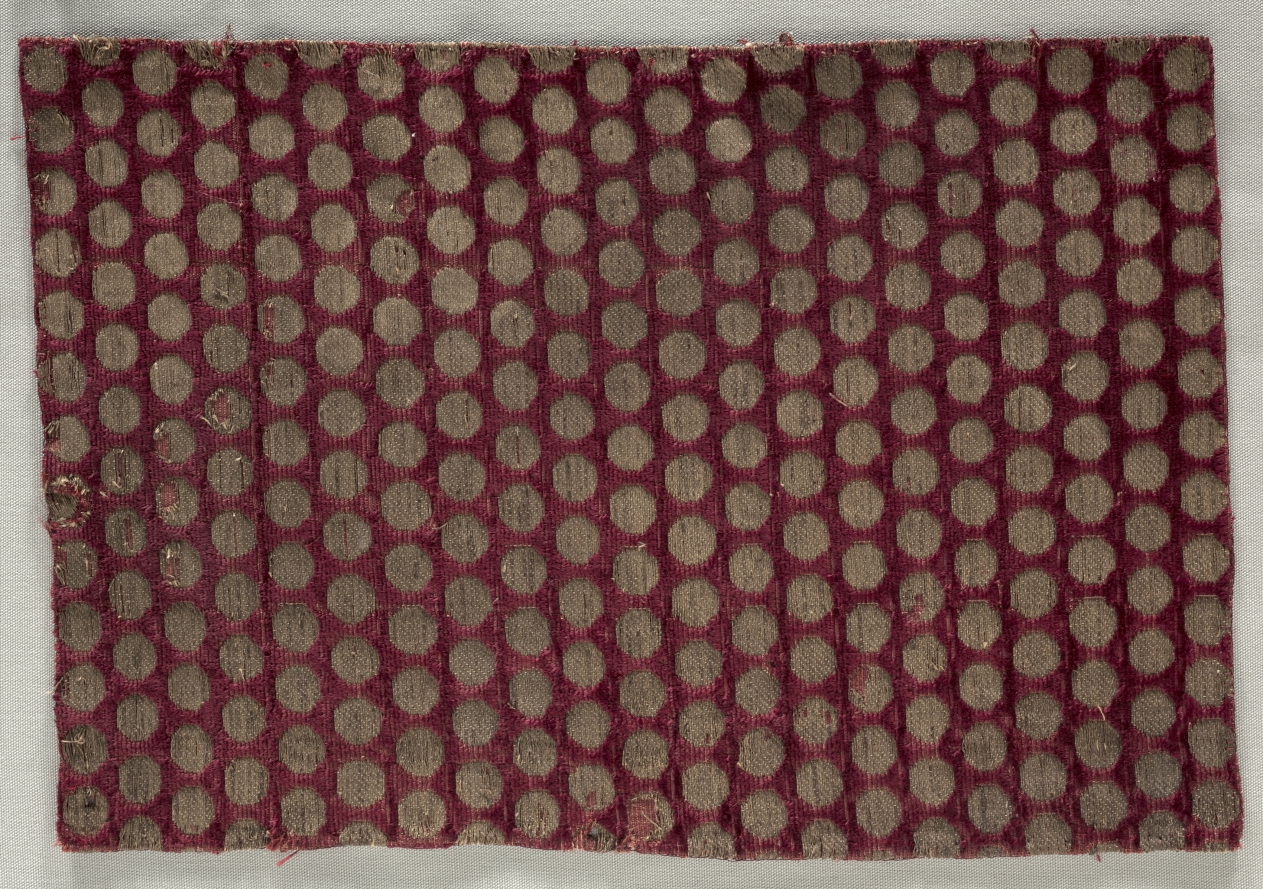
Velvet with gold discs (late 1200s or earlier) is in the Cleveland Museum of Art collection.
The work and its context
The museum's open-access catalogue describes the work:
Silk velvet with rich pile is one of the most opulent and prestigious fabrics, especially when embellished with gold thread. This is one of the earliest known velvets. A 1295 inventory of Pope Boniface VIII includes "a piece of red Tartar velvet with gold discs," which probably refers to this velvet pattern. It is attributed to Iran, possibly in Tabriz where Italian agents resided and could have provided the transfer of silk-velvet technology to Italy. Although the origin of velvet is uncertain, silk velvet with an extra silk pile warp was probably developed in a silk weaving country such as Iran. Inventive Iranian weavers may have developed it during the 1200s or earlier; they are acclaimed for producing the most colorful velvets ever during the 1500s and 1600s.
Object facts
- Title: Velvet with gold discs
- Date: late 1200s or earlier
- Culture: Iran, probably Tabriz, Ilkhanid period
- Type: Velvet
- Technique: silk, gilt-metal thread; brocaded velvet
- Dimensions: Overall: 30.5 x 20.6 cm (12 x 8 1/8 in.); Mounted: 34.9 x 25.4 cm (13 3/4 x 10 in.)
- Collection: T - Islamic
- Department: Textiles
- Accession number: 1918.225
Collection credit
Dudley P. Allen Fund
Further reading listed by the museum
- Wardwell, Anne E. "Panni Tartarici: Eastern Islamic Silks Woven with Gold and Silver (13th and 14th Centuries)." In Islamic Art III, 95-173. New York: The Islamic Art Foundation, 1989.
- Hoeniger, Cathleen S. “Cloth of Gold and Silver: Simone Martini's Techniques for Representing Luxury Textiles.” Gesta 30 (2): 154–62.
- Mackie, Louise W. Symbols of Power: Luxury Textiles from Islamic Lands, 7th-21st Century. Cleveland; New Haven: Cleveland Museum of Art; Yale University Press, 2015.
View the collection record
See the museum's photographs and full catalogue entry. Catalogue text is reproduced from the Cleveland Museum of Art's open-access data, with HTML formatting removed. This object and its supplied image are designated CC0.
Sources
More in Lifestyle
Keep reading