Venus after the Bath (c. 1600): Art, History and Details
Venus after the Bath at the Cleveland Museum of Art: c. 1600, bronze. Explore the work's context, creator attribution and collection history.
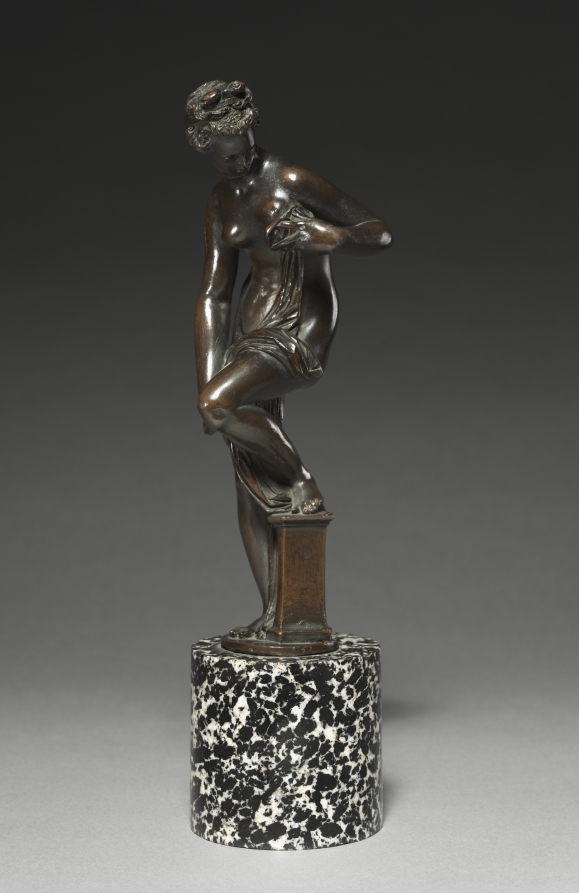
Venus after the Bath (c. 1600) is in the Cleveland Museum of Art collection. The museum's creator attribution is Giambologna (Flemish, active Italy, 1529–1608); Giambologna (Flemish, active Italy, 1529–1608).
The work and its context
The museum's open-access catalogue describes the work:
The statuette’s scale speaks to its likely place in private, intimate settings. The serpentine composition would have encouraged close examination from multiple angles. Compare the complexity of her pose to the relatively static Venus with a Burning Urn (1948.171).
Object facts
- Title: Venus after the Bath
- Date: c. 1600
- Creator attribution: Giambologna (Flemish, active Italy, 1529–1608); Giambologna (Flemish, active Italy, 1529–1608)
- Culture: Italy, early 17th century
- Type: Sculpture
- Technique: bronze
- Dimensions: Overall: 25.6 x 7 x 9 cm (10 1/16 x 2 3/4 x 3 9/16 in.)
- Collection: Sculpture
- Department: European Painting and Sculpture
- Accession number: 1993.230
A detail from the museum
Giambologna intended his bronze statuettes to be held and touched, to fully appreciate their smooth, elegant forms.
Collection credit
Gift of the family of Constance Mather Bishop
View the collection record
See the museum's photographs and full catalogue entry. Catalogue text is reproduced from the Cleveland Museum of Art's open-access data, with HTML formatting removed. This object and its supplied image are designated CC0.
Sources
More in Lifestyle
Keep reading