Virgin and Child in Majesty (c. 1150–1200): Art, History and Details
Virgin and Child in Majesty at the Cleveland Museum of Art: c. 1150–1200, polychrome wood (walnut). Explore the work's context, creator attribution and collection history.
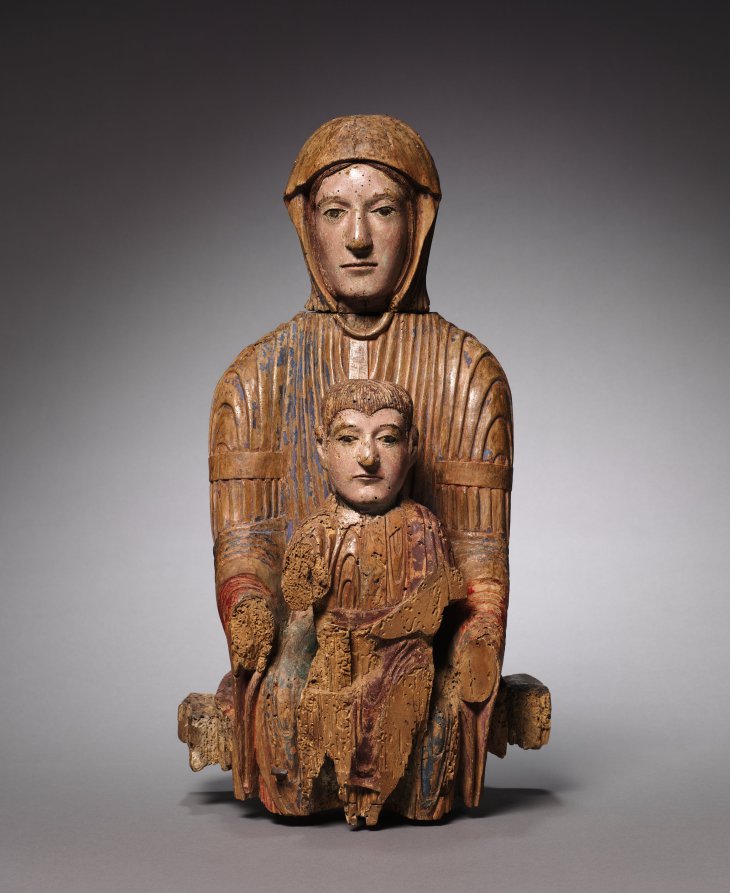
Virgin and Child in Majesty (c. 1150–1200) is in the Cleveland Museum of Art collection.
The work and its context
The museum's open-access catalogue describes the work:
This sculpture belongs to a group of early representations of the Virgin and Child known as the Sedes Sapientiae (the Throne of Wisdom). The subject embodies a complex and core Christian doctrine of the Virgin’s role in the Incarnation (the moment in which Christ became flesh) and ultimately in the redemption of humankind. Mary faces forward, her gaze toward the beholder. As she is seated on a throne, she in turn becomes the throne to the Christ child, thus symbolizing her role in giving birth not only to the human Jesus, but also to the divine Christ. The Incarnation gave Mary a unique role as principal mediator between heaven and earth, and between God and humankind. As a result, her image proliferated in art, especially after the 12th century, a period in which there was surging interest in Mary’s life and increasing devotion to her person and images. The sculpture belongs to a rare group of surviving figures produced in the Auvergne region of central France during the second half of the 12th century. These "Auvergne" Virgins are estimated to number only about 25 or 30 and are characterized by their linear, calligraphic draperies, which form beautiful swirls and contours. All such sculptures are smaller than life-size and made of wood in order to make them mobile. Evidence suggests that they were moved from altar to altar or church to church, and were frequently carried in procession within churches and town streets on Marian feast days. The heads were intentionally removable in order to "dress" them in costumes for such processions.
Object facts
- Title: Virgin and Child in Majesty
- Date: c. 1150–1200
- Culture: France, Auvergne
- Type: Sculpture
- Technique: polychrome wood (walnut)
- Dimensions: Overall: 40 x 22 x 24 cm (15 3/4 x 8 11/16 x 9 7/16 in.)
- Collection: MED - Romanesque
- Department: Medieval Art
- Accession number: 2012.52
A detail from the museum
In this sculpture of Mary and Jesus, their heads are detachable.
Collection credit
Severance and Greta Millikin Purchase Fund
Further reading listed by the museum
- Cleveland Museum of Art. Cleveland Art: The Cleveland Museum of Art Members Magazine. Vol. 53 no. 02, March/April 2013
- Cleveland Museum of Art. The CMA Companion: A Guide to the Cleveland Museum of Art. Cleveland: Cleveland Museum of Art, 2014.
- Riordan, Michelle. Muire na mbard: Móradh na Maighdine. Baile Átha Cliath: Foilseacháin Ábhair Spioradálta, 2016.
View the collection record
See the museum's photographs and full catalogue entry. Catalogue text is reproduced from the Cleveland Museum of Art's open-access data, with HTML formatting removed. This object and its supplied image are designated CC0.
Sources
More in Lifestyle
Keep reading