Vishnu (650–700): Art, History and Details
Vishnu at the Cleveland Museum of Art: 650–700, sandstone. Explore the work's context, creator attribution and collection history.
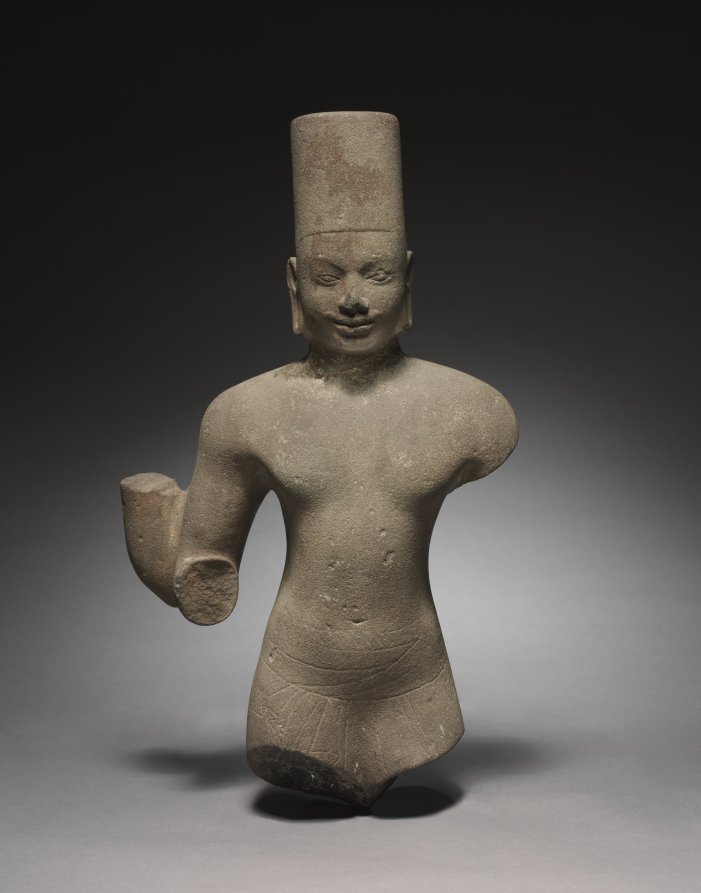
Vishnu (650–700) is in the Cleveland Museum of Art collection.
The work and its context
The museum's open-access catalogue describes the work:
Vishnu has the features of royalty, indicated by the high mitre-like crown with the flat top, distinctive to types made at the site of Prasat Andet. His status as a god, greater than any earthly king, is indicated by the four arms, traces of which are still visible. The sensitive rendering of the eyes and slight smile are characteristics of Cambodian sculpture, and during this early period, the form of the body reveals some relatively naturalistic musculature and treatment of the garments. He wears the Southeast Asian lower garment called sampot, around which his upper garment is loosely tied. It is Vishnu who incarnates himself into the world in avatars, including Krishna and the boar Varaha. Here we see his iconic form as Vishnu himself.
Object facts
- Title: Vishnu
- Date: 650–700
- Culture: Cambodia
- Type: Sculpture
- Technique: sandstone
- Dimensions: Overall: 49.9 cm (19 5/8 in.)
- Collection: Cambodian Art
- Department: Indian and Southeast Asian Art
- Accession number: 1942.563
A detail from the museum
The deity is four-armed with the arms running parallel from the shoulders and then bifurcating at the elbows.
Collection credit
Leonard C. Hanna Jr. Fund
Further reading listed by the museum
- Hollis, Howard. "Two Pre-Khmer Statues of Vishnu." The Bulletin of the Cleveland Museum of Art 29, no. 10 (December 1942): 164–166.
View the collection record
See the museum's photographs and full catalogue entry. Catalogue text is reproduced from the Cleveland Museum of Art's open-access data, with HTML formatting removed. This object and its supplied image are designated CC0.
Sources
More in Lifestyle
Keep reading