Vulture Headdress Inlay (100–1 BCE): Art, History and Details
Vulture Headdress Inlay at the Cleveland Museum of Art: 100–1 BCE, gold and semi-precious stones. Explore the work's context, creator attribution and collection history.
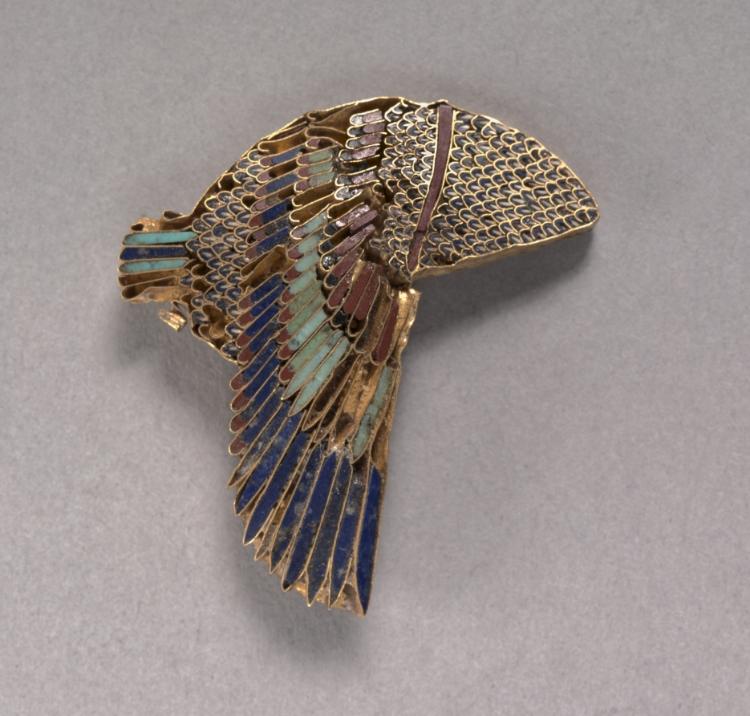
Vulture Headdress Inlay (100–1 BCE) is in the Cleveland Museum of Art collection.
The work and its context
The museum's open-access catalogue describes the work:
The vulture headdress was worn by goddesses and queens. This inlay in the form of a vulture headdress has more than 100 stones: lapis lazuli (dark blue), turquoise (light blue), petrified wood (red), and an unidentified white stone painstakingly cut to shape and separated by thin plates of gold. Body, wing, and tail feathers are carefully distinguished in minute detail.
Object facts
- Title: Vulture Headdress Inlay
- Date: 100–1 BCE
- Culture: Egypt, Greco-Roman period (332 BCE–395 CE), Ptolemaic dynasty (305–30 BCE)
- Type: Jewelry
- Technique: gold and semi-precious stones
- Dimensions: Overall: 3 x 2.8 cm (1 3/16 x 1 1/8 in.)
- Collection: Egypt - Ptolemaic Dynasty
- Department: Egyptian and Ancient Near Eastern Art
- Accession number: 1920.1991
A detail from the museum
When creating this headdress, artisans used numerous semiprecious stones with inset partitions to keep them separate. To ensure that the stones would stay in place, a resin-like material was used as an adhesive.
Collection credit
Gift of the John Huntington Art and Polytechnic Trust
Further reading listed by the museum
- The Illustrated London News (3 November 1928)
- Bates, Kenneth F. The Enamelist. Cleveland and New York: World Pub. Co, 1967.
- Cooney, John D. "Three Minor Masterpieces of Egyptian Art." The Bulletin of the Cleveland Museum of Art 62, no. 1 (1975)
View the collection record
See the museum's photographs and full catalogue entry. Catalogue text is reproduced from the Cleveland Museum of Art's open-access data, with HTML formatting removed. This object and its supplied image are designated CC0.
Sources
More in Lifestyle
Keep reading
Related stories