Walking Buddha (700s): Art, History and Details
Walking Buddha at the Cleveland Museum of Art: 700s, ivory. Explore the work's context, creator attribution and collection history.
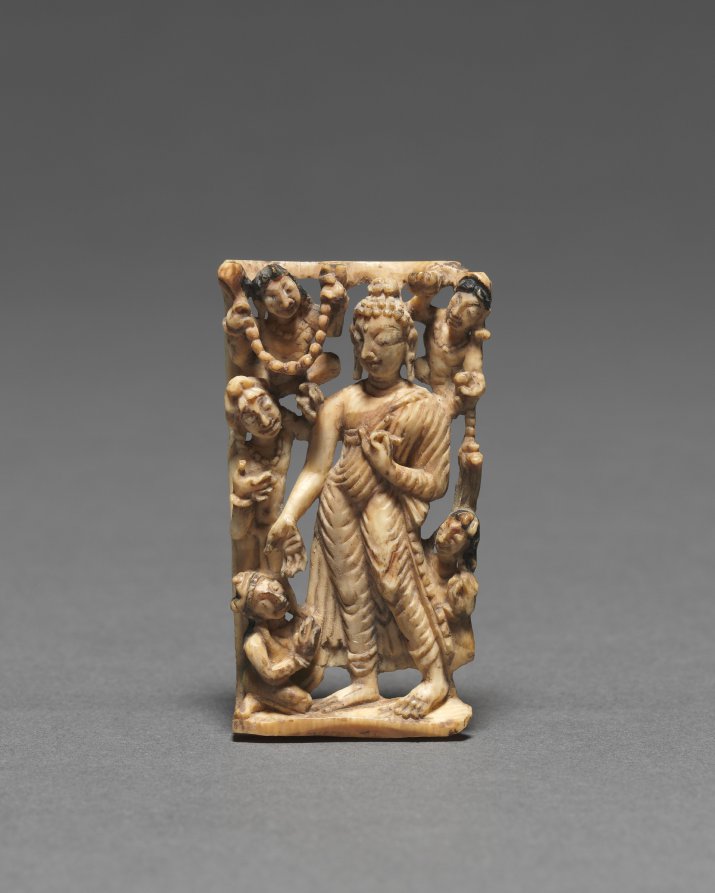
Walking Buddha (700s) is in the Cleveland Museum of Art collection.
The work and its context
The museum's open-access catalogue describes the work:
Small, delicately carved ivory plaques were set into wooden shrines, carved with architectural motifs. This sculpted plaque would have once flanked a central seated Buddha, with a similar standing or walking Buddha on the opposite side. The pleated garment folds derived from Greco-Roman styles adopted in the ancient region of Gandhara, west of Kashmir, where this sculpture was made.
Object facts
- Title: Walking Buddha
- Date: 700s
- Culture: India, Kashmir, 8th century
- Type: Ivory
- Technique: ivory
- Dimensions: Overall: 4.8 x 2.8 x 0.6 cm (1 7/8 x 1 1/8 x 1/4 in.)
- Collection: Indian Art
- Department: Indian and Southeast Asian Art
- Accession number: 1962.167
Collection credit
Purchase from the J. H. Wade Fund
Further reading listed by the museum
- Lee, Sherman E. “Clothed in the Sun: A Buddha and a Surya from Kashmir.” The Bulletin of the Cleveland Museum of Art 54, no. 2 (February 1967): 42–63.
- Tardy. Les ivoires; évolution décorative du Ier siècle à nos jours. Paris: Tardy, 1972.
- Czuma, Stanislaw. "A Unique Addition to the School of Kashmiri Ivories." The Bulletin of the Cleveland Museum of Art 75, no. 8 (October 1988): 298–319.
View the collection record
See the museum's photographs and full catalogue entry. Catalogue text is reproduced from the Cleveland Museum of Art's open-access data, with HTML formatting removed. This object and its supplied image are designated CC0.
Sources
More in Lifestyle
Keep reading