Wall Hanging (1850–1899): Art, History and Details
Wall Hanging at the Cleveland Museum of Art: 1850–1899, Silk, cotton; plain weave, embroidery, tambour chain stitch. Explore the work's context, creator attribution and collection history.
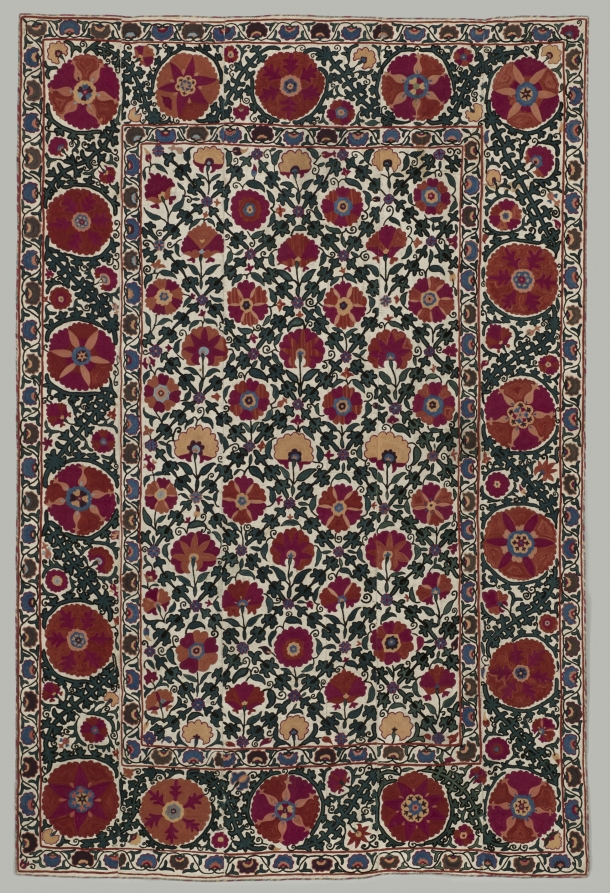
Wall Hanging (1850–1899) is in the Cleveland Museum of Art collection.
The work and its context
The museum's open-access catalogue describes the work:
Embroideries known as suzani, after the Persian and Tajik word for needle (suzan), feature bold floral and foliate motifs enriched with several shades of red and crimson silk thread. This example suggests a lush garden enriched with single flowering plants alternating with a bird’s-eye view of blossoms in a foliate diamond trellis. Either a skilled family member or a professional drew the pattern in black ink (still visible) on five loosely joined cotton cloths; female family members disassembled them for stitching and reassembled them upon completion. Suzanis were made in many towns, generally with distinctive artistic and technical characteristics.
Object facts
- Title: Wall Hanging
- Date: 1850–1899
- Culture: Uzbekistan, Bukhara or Shahr-i Sabz, 19th century
- Type: Embroidery
- Technique: Silk, cotton; plain weave, embroidery, tambour chain stitch
- Dimensions: Average: 248.5 x 161.3 cm (97 13/16 x 63 1/2 in.)
- Collection: T - Islamic
- Department: Textiles
- Accession number: 1940.602
Collection credit
Bequest of James Parmelee
Further reading listed by the museum
- Vok, Ignazio, and Jakob Taube. Suzani: a textile art from Central Asia: Vok collection. 1994.
View the collection record
See the museum's photographs and full catalogue entry. Catalogue text is reproduced from the Cleveland Museum of Art's open-access data, with HTML formatting removed. This object and its supplied image are designated CC0.
Sources
More in Lifestyle
Keep reading