Water Container (Mizusashi) with Riverscape (late 1500s–early 1600s): Art, History and Details
Water Container (Mizusashi) with Riverscape at the Cleveland Museum of Art: late 1500s–early 1600s, Stoneware with underglaze iron oxide slip decoration (Mino ware, Shino type). Explore the work's context, creator attribution and collection
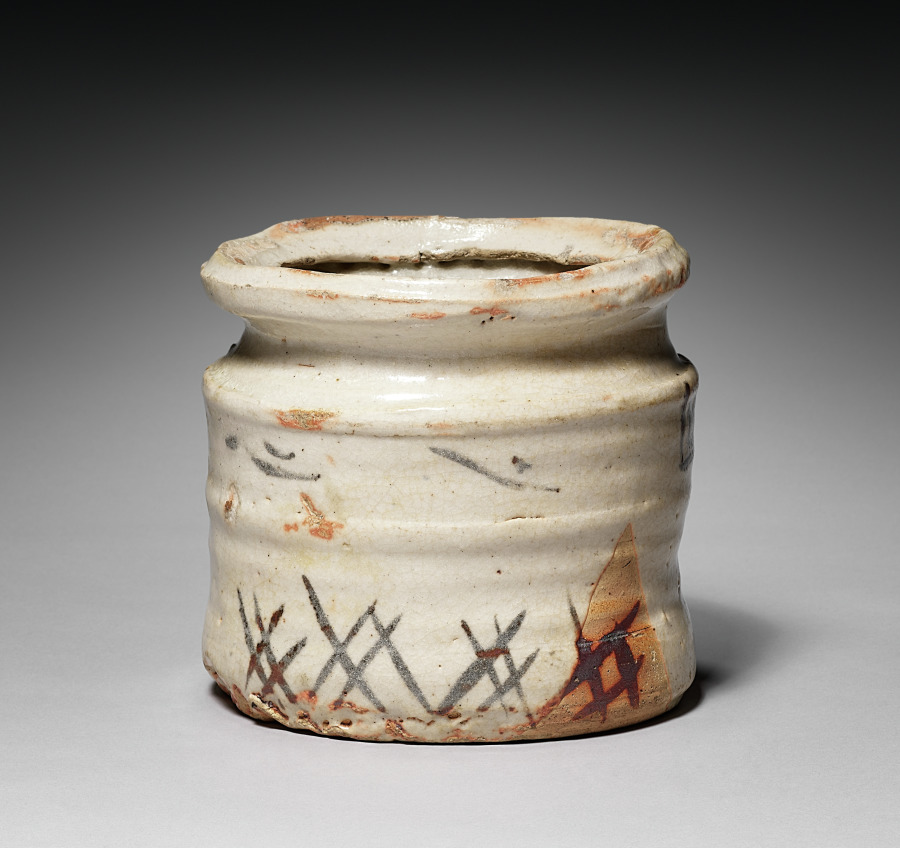
Water Container (Mizusashi) with Riverscape (late 1500s–early 1600s) is in the Cleveland Museum of Art collection.
The work and its context
The museum's open-access catalogue describes the work:
Mizusashi are jars used to hold water for the preparation of tea at tea gatherings. This one was produced in the Mino area of present-day Gifu prefecture in central Japan, and is considered one of the finest of its type in existence, based on the complex aesthetic sensibilities developed around the tea ceremony in Japan. It is called a “picture Shino” (e-shino) mizusashi, as it has an abstracted design said to resemble an ink painting of reeds along a river bank and small boats in a river on one side, and a geometric pattern on the other. With its irregular shape and thick, luminous glaze, it is of a variety favored by eminent tea masters of the Momoyama period.
Object facts
- Title: Water Container (Mizusashi) with Riverscape
- Date: late 1500s–early 1600s
- Culture: Japan, Momoyama period (1573-1615) to Edo period (1615-1858)
- Type: Ceramic
- Technique: Stoneware with underglaze iron oxide slip decoration (Mino ware, Shino type)
- Dimensions: Diameter: 19.6 cm (7 11/16 in.); Lid: 2.9 x 14.7 cm (1 1/8 x 5 13/16 in.); Container: 18.4 cm (7 1/4 in.)
- Collection: Japanese Art
- Department: Japanese Art
- Accession number: 1972.9.a
A detail from the museum
The water this container held during a tea ceremony was used to fill the kama, or iron pot in which the water is heated.
Collection credit
John L. Severance Fund
Further reading listed by the museum
- The Cleveland Museum of Art. Handbook of the Cleveland Museum of Art/1978. Cleveland, OH: The Cleveland Museum of Art, 1978.
- Cunningham, Michael R. The Triumph of Japanese Style: 16th-Century Art in Japan. [Cleveland, Ohio]: Published by the Cleveland Museum of Art in cooperation with the Indiana University Press, 1991.
- Takeuchi, Junʼichi 竹内順一, and Dean Robson. Oribe, iwayuru Oribeizumu ni tsuite: Gifuken Bijutsukan kaikan 15-shūnen kinenten [織部, いわゆるオリベイズムについて : 岐阜県美術館開館 15周年記念 = Oribe, (re)searching "Oribeism" : special exhibition for the 15th anniversary of the Museum of Fine Arts, Gifu]. Gifu-shi: Gifu-ken Bijutsukan, 1997.
View the collection record
See the museum's photographs and full catalogue entry. Catalogue text is reproduced from the Cleveland Museum of Art's open-access data, with HTML formatting removed. This object and its supplied image are designated CC0.
Sources
More in Lifestyle
Keep reading