Water Ewer for Rituals (Kundika) (1100s): Art, History and Details
Water Ewer for Rituals (Kundika) at the Cleveland Museum of Art: 1100s, bronze. Explore the work's context, creator attribution and collection history.
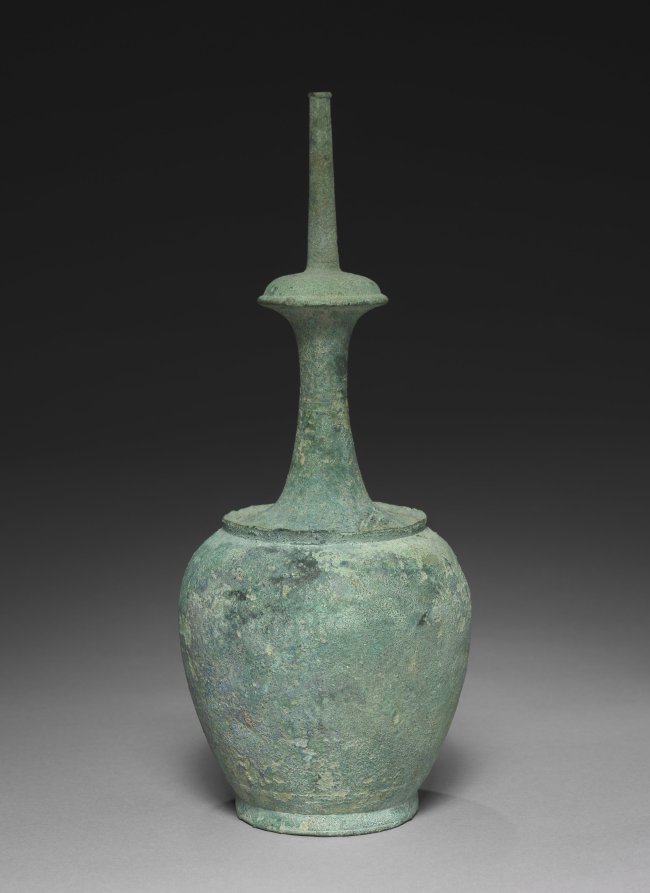
Water Ewer for Rituals (Kundika) (1100s) is in the Cleveland Museum of Art collection.
The work and its context
The museum's open-access catalogue describes the work:
Known as kundika in Sanskrit, this distinctively shaped vessel served to purify a sacred space and to invoke a deity. In Korean Buddhist art, it appears primarily as an attribute of the Bodhisattva Avalokitesvara (Gwaneum in Korean). By the 12th century, however, it came to serve as aristocrats’ fancy water container for everyday use.
Object facts
- Title: Water Ewer for Rituals (Kundika)
- Date: 1100s
- Culture: Korea, Goryeo dynasty (918–1392)
- Type: Metalwork
- Technique: bronze
- Dimensions: Outer diameter: 13.7 cm (5 3/8 in.); Overall: 33 cm (13 in.)
- Collection: Korean Art
- Department: Korean Art
- Accession number: 1992.141
A detail from the museum
This distinctively shaped vessel is called a kundika in Sanskrit, simply referring to a water bottle.
Collection credit
Seventy-fifth anniversary gift of Robert Moore
Further reading listed by the museum
- Turner, Evan H. “The Year in Review for 1992.” The Bulletin of the Cleveland Museum of Art 80, no. 2 (February 1993): 38–79.
- Goryeo Dynasty: Korea's Age of Enlightenment, 918-1392. San Francisco: Asian Art Museum, 2003.
- Goryeo: The Glory of Korea [대고려, 그 찬란한 도전]. Seoul: National Museum of Korea, 2018.
View the collection record
See the museum's photographs and full catalogue entry. Catalogue text is reproduced from the Cleveland Museum of Art's open-access data, with HTML formatting removed. This object and its supplied image are designated CC0.
Sources
More in Lifestyle
Keep reading