Water Ewer for Rituals (Kundika) with Incised Parrot Design (1100s): Art, History and Details
Water Ewer for Rituals (Kundika) with Incised Parrot Design at the Cleveland Museum of Art: 1100s, stoneware with celadon glaze, incised and carved decoration. Explore the work's context, creator attribution and collection history.
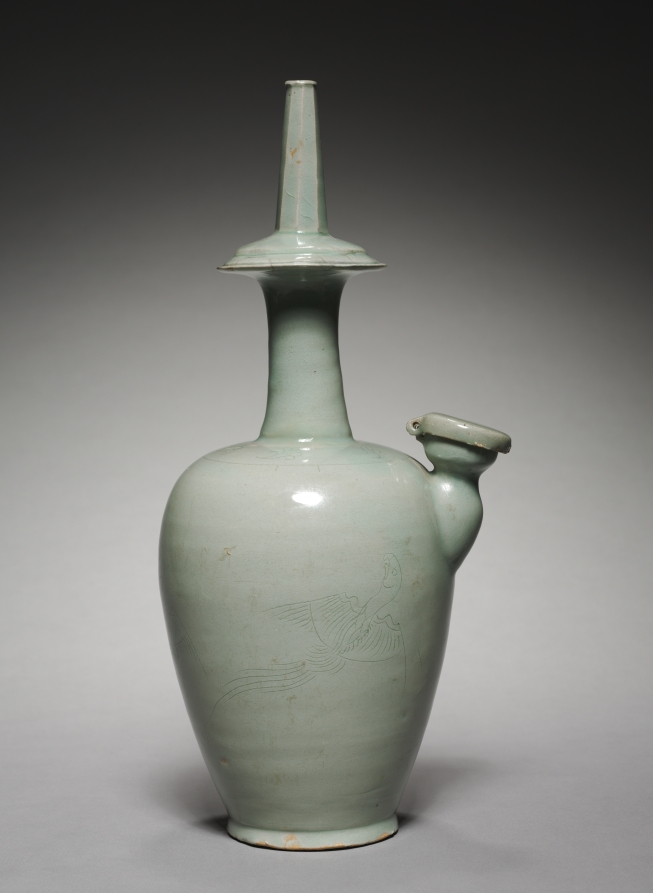
Water Ewer for Rituals (Kundika) with Incised Parrot Design (1100s) is in the Cleveland Museum of Art collection.
The work and its context
The museum's open-access catalogue describes the work:
This distinctively shaped celadon vessel is a kundika. With a spout on one side, this type of vessel is often used in Buddhist purification rituals. Unlike most existing examples that have an image of a willow tree, this work has a rare flying phoenix design incised on its surface. During the Goryeo period (918-1392), about 260 kilns operated in mainly Jeolla and Chungcheong provinces, meeting a soaring demand for high-end products like this example.
Object facts
- Title: Water Ewer for Rituals (Kundika) with Incised Parrot Design
- Date: 1100s
- Culture: Korea, Goryeo dynasty (918–1392)
- Type: Ceramic
- Technique: stoneware with celadon glaze, incised and carved decoration
- Dimensions: Overall: 35.3 cm (13 7/8 in.)
- Collection: Korean Art
- Department: Korean Art
- Accession number: 1921.631
A detail from the museum
Unlike most existing examples that have an image of a willow tree or lotus pond, this ewer bears an image of flying parrots delicately incised on its surface.
Collection credit
Gift of John L. Severance
Further reading listed by the museum
- Other types of Goryeo-period kundika can be found in the collection of the National Museum of Asian Art (Washington DC).
- Cleveland Museum of Art, and Jenifer Neils. The World of Ceramics: Masterpieces from the Cleveland Museum of Art. Cleveland: Museum in cooperation with Indiana University Press, 1982.
- Goryeo Dynasty: Korea's Age of Enlightenment, 918-1392. San Francisco: Asian Art Museum, 2003.
View the collection record
See the museum's photographs and full catalogue entry. Catalogue text is reproduced from the Cleveland Museum of Art's open-access data, with HTML formatting removed. This object and its supplied image are designated CC0.
Sources
More in Lifestyle
Keep reading