Water Jar (Olla) (1150–1325): Art, History and Details
Water Jar (Olla) at the Cleveland Museum of Art: 1150–1325, Ceramic, slip. Explore the work's context, creator attribution and collection history.
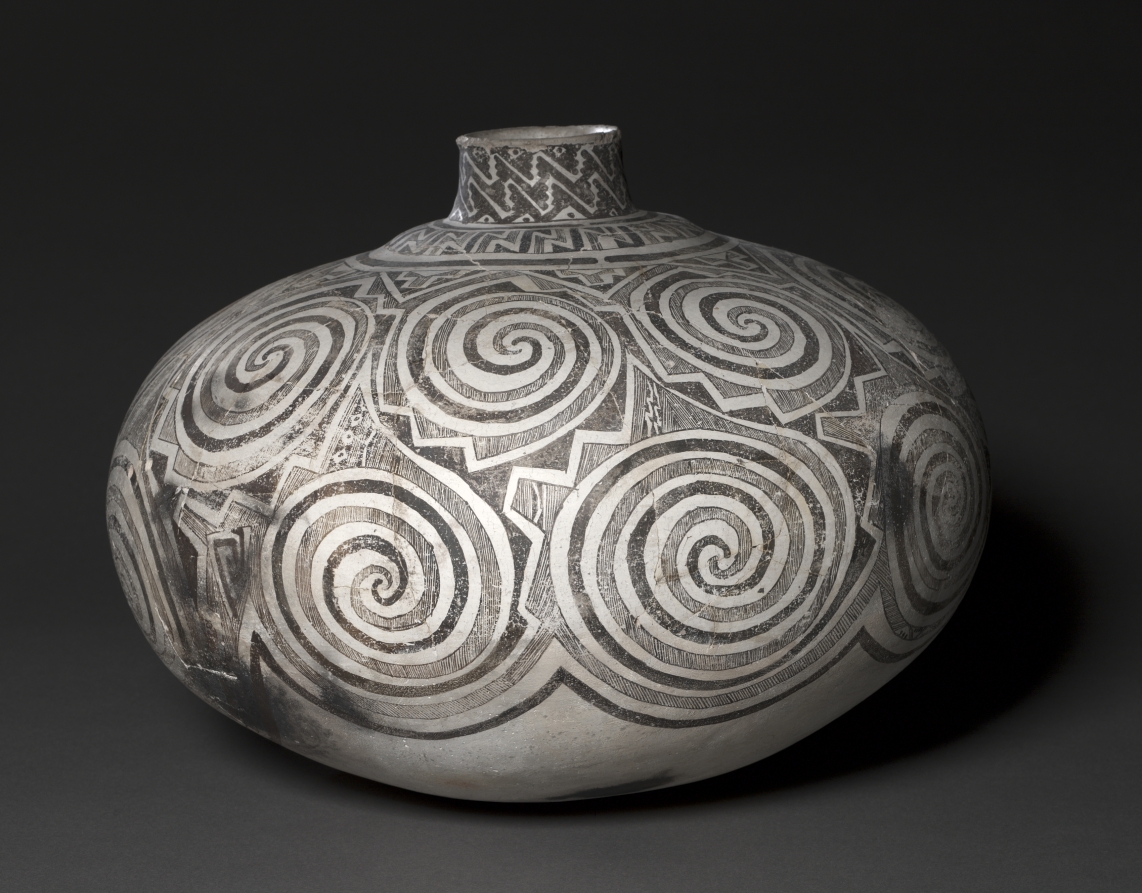
Water Jar (Olla) (1150–1325) is in the Cleveland Museum of Art collection.
The work and its context
The museum's open-access catalogue describes the work:
Ancestral Pueblo ceramics feature striking black-and-white geometric motifs, here interconnected spirals interrupted by jagged lines. Meaning is unknown, but the complex pattern is reminiscent of water that eddies as it runs over rocks. With recent exceptions, pottery is a women’s art among modern Pueblo peoples who descend from the Ancestral Pueblo; the same was likely true in the ancient past. As today, the potter created her wares by coiling ropes of clay atop one another, smoothing and further shaping them, and then applying decoration with brushes made of maguey (agave) or yucca leaf chewed until the fibers formed bristles.
Object facts
- Title: Water Jar (Olla)
- Date: 1150–1325
- Culture: Southwest, Ancestral Pueblo, Tularosa Black-on-White style
- Type: Ceramic
- Technique: Ceramic, slip
- Dimensions: Overall: 30 x 40.5 cm (11 13/16 x 15 15/16 in.)
- Collection: AA - Native North America
- Department: Art of the Americas
- Accession number: 1984.159
Collection credit
Purchase from the J. H. Wade Fund
Further reading listed by the museum
- Turner, Evan H. “The Year in Review for 1984.” The Bulletin of the Cleveland Museum of Art 72, no. 2 (April 1985): 163–207.
- Sims, Lowery Stokes. The Persistence of Geometry: Form, Content, and Culture in the Collection of the Cleveland Museum of Art. Cleveland: Cleveland Museum of Art, 2006.
View the collection record
See the museum's photographs and full catalogue entry. Catalogue text is reproduced from the Cleveland Museum of Art's open-access data, with HTML formatting removed. This object and its supplied image are designated CC0.
Sources
More in Lifestyle
Keep reading