Water Jar (Olla) with Rosettes (1880s): Art, History and Details
Water Jar (Olla) with Rosettes at the Cleveland Museum of Art: 1880s, ceramic, slip. Explore the work's context, creator attribution and collection history.
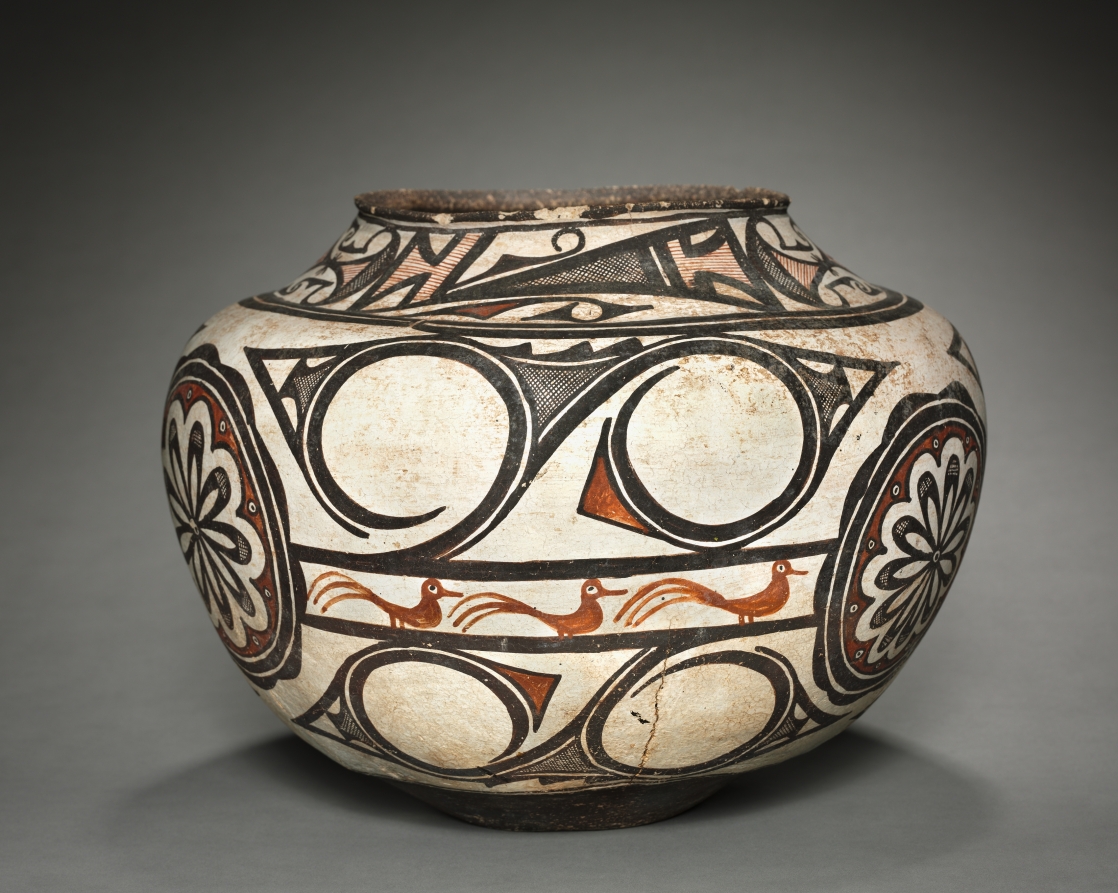
Water Jar (Olla) with Rosettes (1880s) is in the Cleveland Museum of Art collection.
The work and its context
The museum's open-access catalogue describes the work:
In the past, motifs painted on Zuni (A:shiwi) ceramics likely held symbolic meanings but, if so, they are largely lost to memory—or at least the Zuni do not discuss them today. Where known, they seem to concern water, verdant crops, and abundant wildlife, also the focus of much Pueblo religious life. For instance, the large, triangular, blade-like forms around this vessel’s neck may represent the thunder knife used in many ceremonies. The petaled forms in circular rosettes refer to sunflowers.
Object facts
- Title: Water Jar (Olla) with Rosettes
- Date: 1880s
- Culture: Native North America, Southwest, New Mexico, Zuni (A:shiwi) Pueblo
- Type: Ceramic
- Technique: ceramic, slip
- Dimensions: Overall: 27.5 x 36 cm (10 13/16 x 14 3/16 in.)
- Collection: AA - Native North America
- Department: Art of the Americas
- Accession number: 1928.323
Collection credit
Educational Purchase Fund
View the collection record
See the museum's photographs and full catalogue entry. Catalogue text is reproduced from the Cleveland Museum of Art's open-access data, with HTML formatting removed. This object and its supplied image are designated CC0.
Sources
More in Lifestyle
Keep reading