Water-Moon Kannon (c. 1500): Art, History and Details
Water-Moon Kannon at the Cleveland Museum of Art: c. 1500, Hanging scroll; ink on paper. Explore the work's context, creator attribution and collection history.
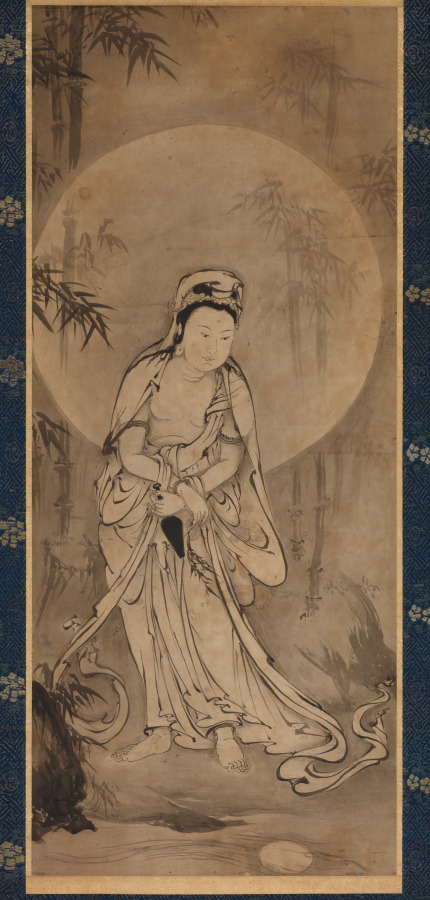
Water-Moon Kannon (c. 1500) is in the Cleveland Museum of Art collection. The museum's creator attribution is Gakuō Zōkyū (Japanese, active about 1482–1514).
The work and its context
The museum's open-access catalogue describes the work:
This painting of Kannon, a Buddhist deity of mercy and compassion with many forms. is attributed to Gakuō Zōkyū, a well-known Zen monk who specialized in ink painting. Kannon looks at the moon reflected in the water, a symbol of impermanence, and holds a willow branch and water vase symbolizing healing and purification.
Object facts
- Title: Water-Moon Kannon
- Date: c. 1500
- Creator attribution: Gakuō Zōkyū (Japanese, active about 1482–1514)
- Culture: Japan, Muromachi period (1392–1573)
- Type: Painting
- Technique: Hanging scroll; ink on paper
- Dimensions: Painting: 104.8 x 44 cm (41 1/4 x 17 5/16 in.); Mounted: 207 x 62.5 cm (81 1/2 x 24 5/8 in.)
- Collection: ASIAN - Hanging scroll
- Department: Japanese Art
- Accession number: 1985.110
A detail from the museum
Kannon is a bodhisattva—a being capable of enlightenment, but who delays it in order to help other beings.
Collection credit
John L. Severance Fund
Further reading listed by the museum
- Turner, Evan H. “The Year in Review for 1985.” The Bulletin of the Cleveland Museum of Art 73, no. 2 (1986): 26–71.
- Cunningham, Michael R. and others. Masterworks of Asian Art. Cleveland, OH: Cleveland Museum of Art, 1998.
View the collection record
See the museum's photographs and full catalogue entry. Catalogue text is reproduced from the Cleveland Museum of Art's open-access data, with HTML formatting removed. This object and its supplied image are designated CC0.
Sources
More in Lifestyle
Keep reading