Whistle (kasengosengo) (late 1800s): Art, History and Details
Whistle (kasengosengo) at the Cleveland Museum of Art: late 1800s, Probably hippopotamus ivory. Explore the work's context, creator attribution and collection history.
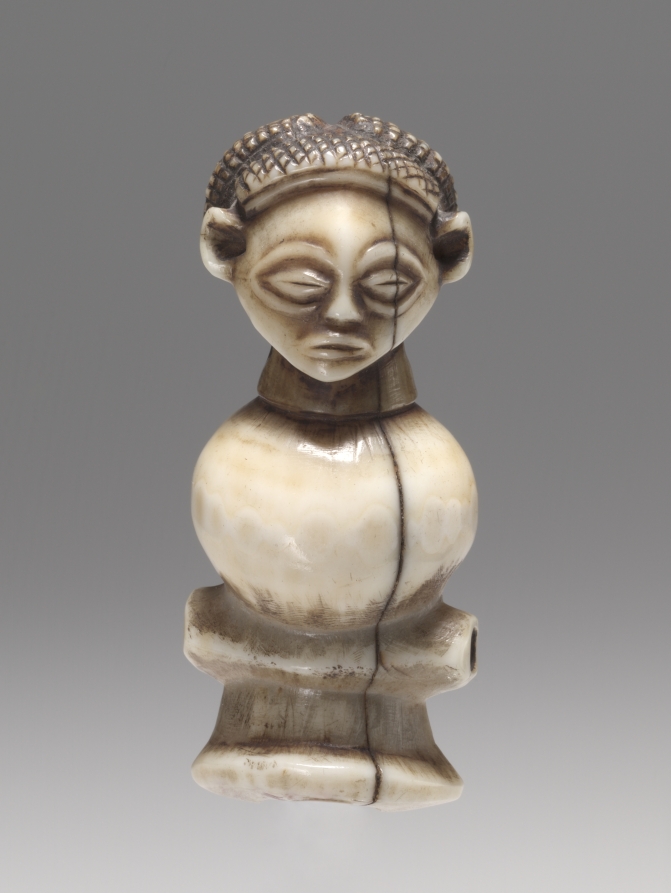
Whistle (kasengosengo) (late 1800s) is in the Cleveland Museum of Art collection.
The work and its context
The museum's open-access catalogue describes the work:
Carved out of ivory or wood in a variety of shapes, Chokwe whistles often bear miniature, stylized renderings of masks. Cikunza, the "patron saint" of the boys' initiation into manhood, is depicted with a pointed extension imitating the horn of a road antelope, symbolizing the fertility spirit. Typically such whistles were used by men during the hunt to communicate with their co-hunters and to call their dogs. They were either worn attached to a string as a necklace or tied to a spear.
Object facts
- Title: Whistle (kasengosengo)
- Date: late 1800s
- Culture: Central Africa, Democratic Republic of Congo or Angola, Chokwe people
- Type: Musical Instrument
- Technique: Probably hippopotamus ivory
- Dimensions: Overall: 7.3 x 3.2 cm (2 7/8 x 1 1/4 in.)
- Collection: African Art
- Department: African Art
- Accession number: 1915.443
A detail from the museum
This was the first sculptural work from Africa to enter the CMA's collection.
Collection credit
Educational Purchase Fund
View the collection record
See the museum's photographs and full catalogue entry. Catalogue text is reproduced from the Cleveland Museum of Art's open-access data, with HTML formatting removed. This object and its supplied image are designated CC0.
Sources
More in Lifestyle
Keep reading