White-Robed Kannon (Byakue Kannon) (c. 1200): Art, History and Details
White-Robed Kannon (Byakue Kannon) at the Cleveland Museum of Art: c. 1200, hanging scroll; ink on paper. Explore the work's context, creator attribution and collection history.
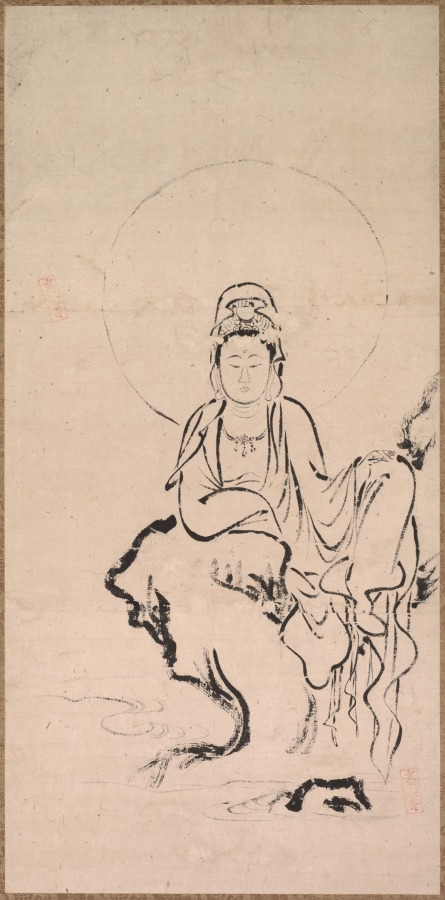
White-Robed Kannon (Byakue Kannon) (c. 1200) is in the Cleveland Museum of Art collection.
The work and its context
The museum's open-access catalogue describes the work:
Kannon is a deity of mercy and compassion in the Buddhist faith. This monochrome sketch comes from Kōzan-ji, a temple in northwest Kyoto. The subdued ink tones and plain brushwork reflect the taste of Zen Buddhism, which began to have an impact on the visual arts in 13th-century Japan.
Object facts
- Title: White-Robed Kannon (Byakue Kannon)
- Date: c. 1200
- Culture: Japan, Kamakura period (1185–1333)
- Type: Painting
- Technique: hanging scroll; ink on paper
- Dimensions: Image: 91.4 x 45.1 cm (36 x 17 3/4 in.); Overall: 178.4 x 64.1 cm (70 1/4 x 25 1/4 in.)
- Collection: ASIAN - Hanging scroll
- Department: Japanese Art
- Accession number: 1951.540
Collection credit
John L. Severance Fund
Further reading listed by the museum
- Lee, Sherman E. “A White-Robed Kwannon from Kōzan-Ji.” The Bulletin of the Cleveland Museum of Art, vol. 39, no. 10, 1952, pp. 235–237.
- Lee, Sherman E. "Shin and Sō." The Bulletin of the Cleveland Museum of Art 43, no. 6 (June 1956): 115–118.
- The Cleveland Museum of Art. The Cleveland Museum of Art Handbook. Cleveland, OH: The Cleveland Museum of Art, 1958.
View the collection record
See the museum's photographs and full catalogue entry. Catalogue text is reproduced from the Cleveland Museum of Art's open-access data, with HTML formatting removed. This object and its supplied image are designated CC0.
Sources
More in Lifestyle
Keep reading