Wild Man (late 1400s): Art, History and Details
Wild Man at the Cleveland Museum of Art: late 1400s, copper alloy. Explore the work's context, creator attribution and collection history.
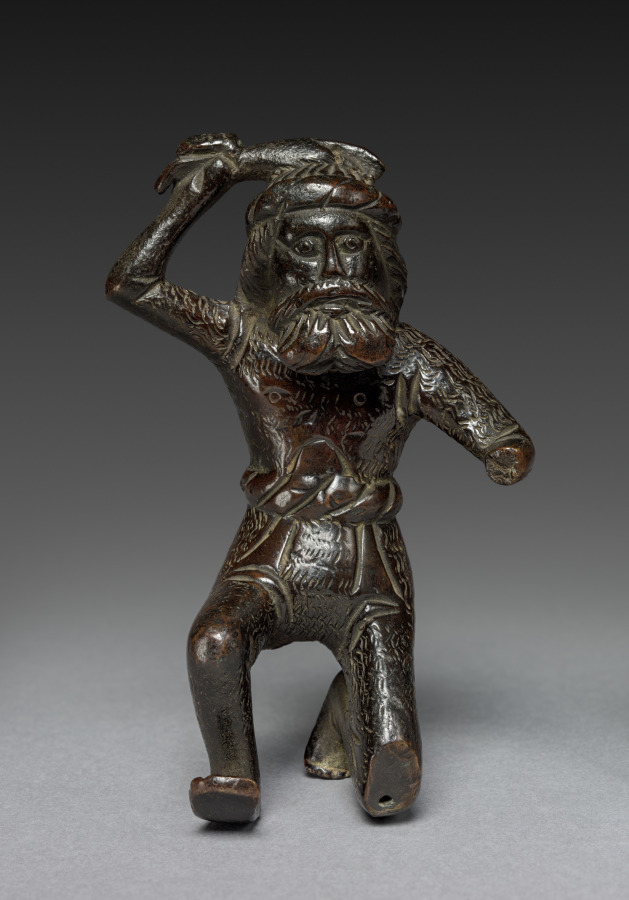
Wild Man (late 1400s) is in the Cleveland Museum of Art collection.
The work and its context
The museum's open-access catalogue describes the work:
Common in medieval art, the wild man is humanlike in appearance with long shaggy hair over his entire body and typically carries a club. Living at the fringe of society in woodland areas, wild men symbolized man in his natural, uncivilized state. Perhaps derived from the part-man part-beast satyr of antiquity, the wild man symbolized lust and aggression in contrast to the spiritual love embodied in medieval chivalry. This bearded version is shown kneeling while raising his right arm holding a club. He wears a twisted cloth circlet on his head and a similar belt at the waist. It has been suggested that this sculpture originally formed part of a suspended candelabra. It may also have served as support for large metal vessels.
Object facts
- Title: Wild Man
- Date: late 1400s
- Culture: Germany, Nuremberg(?)
- Type: Sculpture
- Technique: copper alloy
- Dimensions: Overall: 13.4 cm (5 1/4 in.)
- Collection: MED - Gothic
- Department: Medieval Art
- Accession number: 1965.21
A detail from the museum
The wild man is derived from the Greek satyr who lived in the woods.
Collection credit
Norman O. Stone and Ella A. Stone Memorial Fund, and James Parmelee Fund
Further reading listed by the museum
- Wixom, William D. “Four Late Gothic Additions to the Medieval Treasury.” The Bulletin of the Cleveland Museum of Art 56, no. 9 (November 1969): 320–331.
View the collection record
See the museum's photographs and full catalogue entry. Catalogue text is reproduced from the Cleveland Museum of Art's open-access data, with HTML formatting removed. This object and its supplied image are designated CC0.
Sources
More in Lifestyle
Keep reading