Winter and Summer Flowers (c. 1600): Art, History and Details
Winter and Summer Flowers at the Cleveland Museum of Art: c. 1600, Pair of six-panel folding screens; ink, color, and gold on paper. Explore the work's context, creator attribution and collection history.
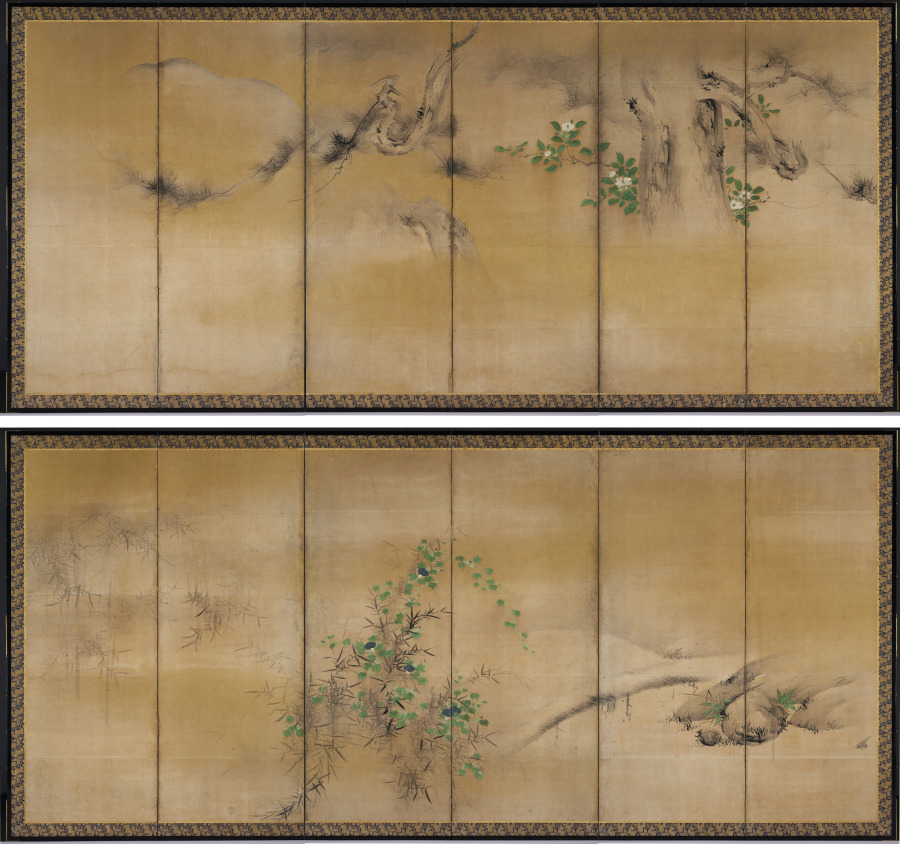
Winter and Summer Flowers (c. 1600) is in the Cleveland Museum of Art collection. The museum's creator attribution is Kaihō Yūshō (Japanese, 1533–1615).
The work and its context
The museum's open-access catalogue describes the work:
White camellias bloom behind a large pine in the right screen and blue morning glories creep through bamboo in the left screen of this composition. The mountains and bridge suggest a continuous landscape, but the paintings actually juxtapose flowers of winter and summer, with time progressing from right to left. Kaihō Yūshō painted similar landscapes for Zen temples in Kyoto.
Object facts
- Title: Winter and Summer Flowers
- Date: c. 1600
- Creator attribution: Kaihō Yūshō (Japanese, 1533–1615)
- Culture: Japan, Momoyama period (1573–1615)
- Type: Painting
- Technique: Pair of six-panel folding screens; ink, color, and gold on paper
- Dimensions: Overall: 174 x 376 cm (68 1/2 x 148 1/16 in.)
- Collection: ASIAN - Folding screen
- Department: Japanese Art
- Accession number: 1987.40
A detail from the museum
The pine and bamboo are defined by ink wash, but the flowers take form through color within contour lines.
Collection credit
John L. Severance Fund
Further reading listed by the museum
- Art of Japan: Paintings, Prints and Screens: Selected Articles from Orientations, 1984-2002. Hong Kong: Orientations Magazine, 2002.
- Turner, Evan H. “The Year in Review for 1987.” The Bulletin of the Cleveland Museum of Art 75, no. 2 (February 1988): 30–71.
- Cunningham, Michael R. The Triumph of Japanese Style: 16th-Century Art in Japan. Cleveland, OH: Published by the Cleveland Museum of Art in cooperation with the Indiana University Press, 1991.
View the collection record
See the museum's photographs and full catalogue entry. Catalogue text is reproduced from the Cleveland Museum of Art's open-access data, with HTML formatting removed. This object and its supplied image are designated CC0.
Sources
More in Lifestyle
Keep reading