Writing Box (Suzuribako) with Pine, Camellia, and Bamboo (1400s): Art, History and Details
Writing Box (Suzuribako) with Pine, Camellia, and Bamboo at the Cleveland Museum of Art: 1400s, Lacquered wood with gold and silver sprinkled powder (maki-e), stone, and metal. Explore the work's context, creator attribution and collection
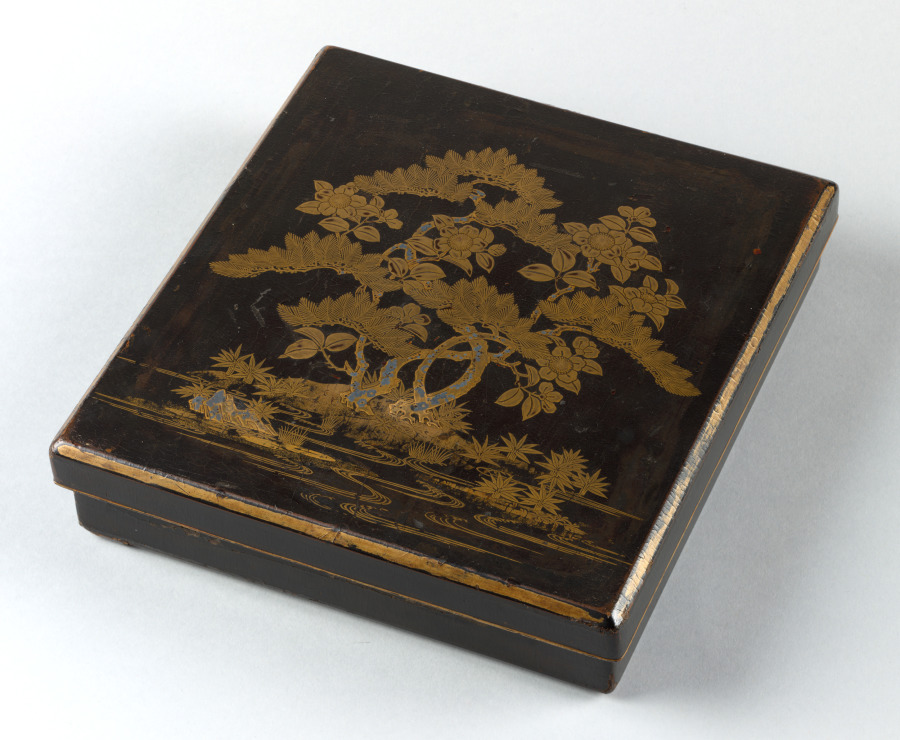
Writing Box (Suzuribako) with Pine, Camellia, and Bamboo (1400s) is in the Cleveland Museum of Art collection.
The work and its context
The museum's open-access catalogue describes the work:
Japanese writing boxes are designed to hold all the tools for traditional calligraphy, including an inkstone, water dropper, ink cake, and brushes. This box retains its inkstone and water dropper, the latter of which has a design of camellia and pine, matching the late winter, early spring lacquer motifs on the lid.
Object facts
- Title: Writing Box (Suzuribako) with Pine, Camellia, and Bamboo
- Date: 1400s
- Culture: Japan, Muromachi period (1392–1573)
- Type: Lacquer
- Technique: Lacquered wood with gold and silver sprinkled powder (maki-e), stone, and metal
- Dimensions: Overall: 24.2 x 22.6 cm (9 1/2 x 8 7/8 in.)
- Collection: Japanese Art
- Department: Japanese Art
- Accession number: 1969.124
A detail from the museum
Pine, bamboo, and plum is a common seasonal motif; here the plum is replaced with camellia.
Collection credit
John L. Severance Fund
Further reading listed by the museum
- “Art of Asia Recently Acquired by American Museums, 1969.” Archives of Asian Art 24 (1970): 86–117.
- Lee, Sherman E. “The Year in Review for 1969.” The Bulletin of the Cleveland Museum of Art 57, no. 1 (January 1970): 2–51.
- The Cleveland Museum of Art. Handbook of the Cleveland Museum of Art/1978. Cleveland, OH: The Cleveland Museum of Art, 1978.
View the collection record
See the museum's photographs and full catalogue entry. Catalogue text is reproduced from the Cleveland Museum of Art's open-access data, with HTML formatting removed. This object and its supplied image are designated CC0.
Sources
More in Lifestyle
Keep reading
Related stories