Youth as a Stand-in Monju (c. 1767): Art, History and Details
Youth as a Stand-in Monju at the Cleveland Museum of Art: c. 1767, color woodblock print. Explore the work's context, creator attribution and collection history.
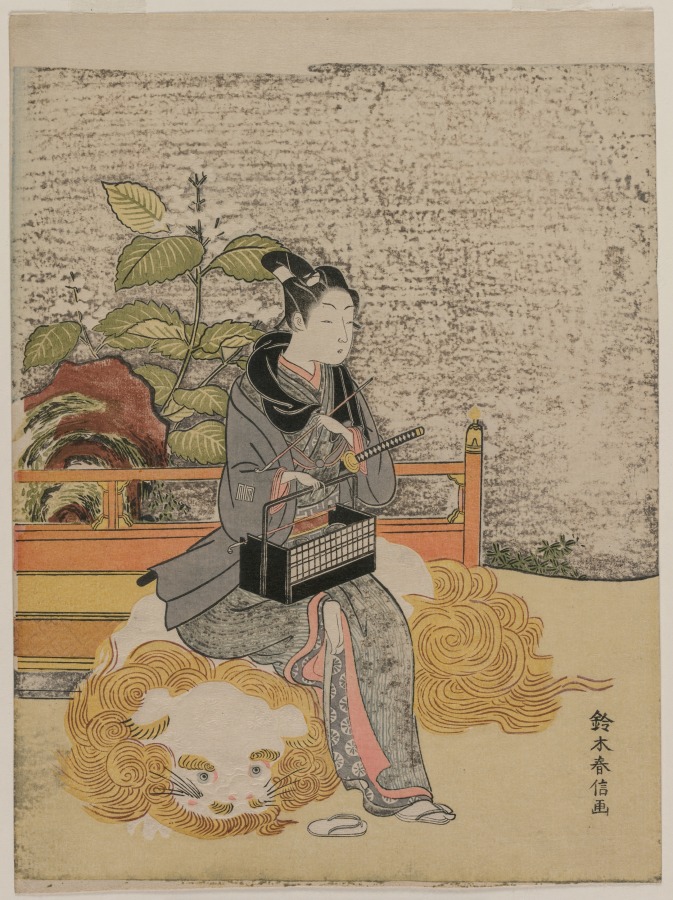
Youth as a Stand-in Monju (c. 1767) is in the Cleveland Museum of Art collection. The museum's creator attribution is Suzuki Harunobu (Japanese, 1724–1770).
The work and its context
The museum's open-access catalogue describes the work:
In this image, a handsome young man replaces the Buddhist figure Monju, a bodhisattva—or enlightened being—often shown riding a lion. Monju symbolizes wisdom and customarily holds a sword and a sacred text atop a lotus flower. The youth here meditates instead on his tobacco kit and a long pipe. The print was once paired with another, showing a young woman replacing Fugen, a bodhisattva who rides an elephant.
Object facts
- Title: Youth as a Stand-in Monju
- Date: c. 1767
- Creator attribution: Suzuki Harunobu (Japanese, 1724–1770)
- Culture: Japan, Edo period (1615–1868)
- Type: Print
- Technique: color woodblock print
- Dimensions: Sheet: 29.2 x 21.7 cm (11 1/2 x 8 9/16 in.)
- Collection: Japanese Art
- Department: Japanese Art
- Accession number: 1930.177
Collection credit
Bequest of Edward L. Whittemore
Further reading listed by the museum
- Hollis, Howard C. "The Edward Loder Whittemore Collection of Japanese Prints." The Bulletin of the Cleveland Museum of Art 17, no. 4 (1930): 64-66.
- Lee, Sherman E. A History of Far Eastern Art. New York: H.N. Abrams, 1964.
- The Cleveland Museum of Art. Handbook of the Cleveland Museum of Art/1978. Cleveland, OH: The Cleveland Museum of Art, 1978.
View the collection record
See the museum's photographs and full catalogue entry. Catalogue text is reproduced from the Cleveland Museum of Art's open-access data, with HTML formatting removed. This object and its supplied image are designated CC0.
Sources
More in Lifestyle
Keep reading