Striped Silk from a Garment (1400s): Art, History and Details
Striped Silk from a Garment at the Cleveland Museum of Art: 1400s, silk; lampas weave. Explore the work's context, creator attribution and collection history.
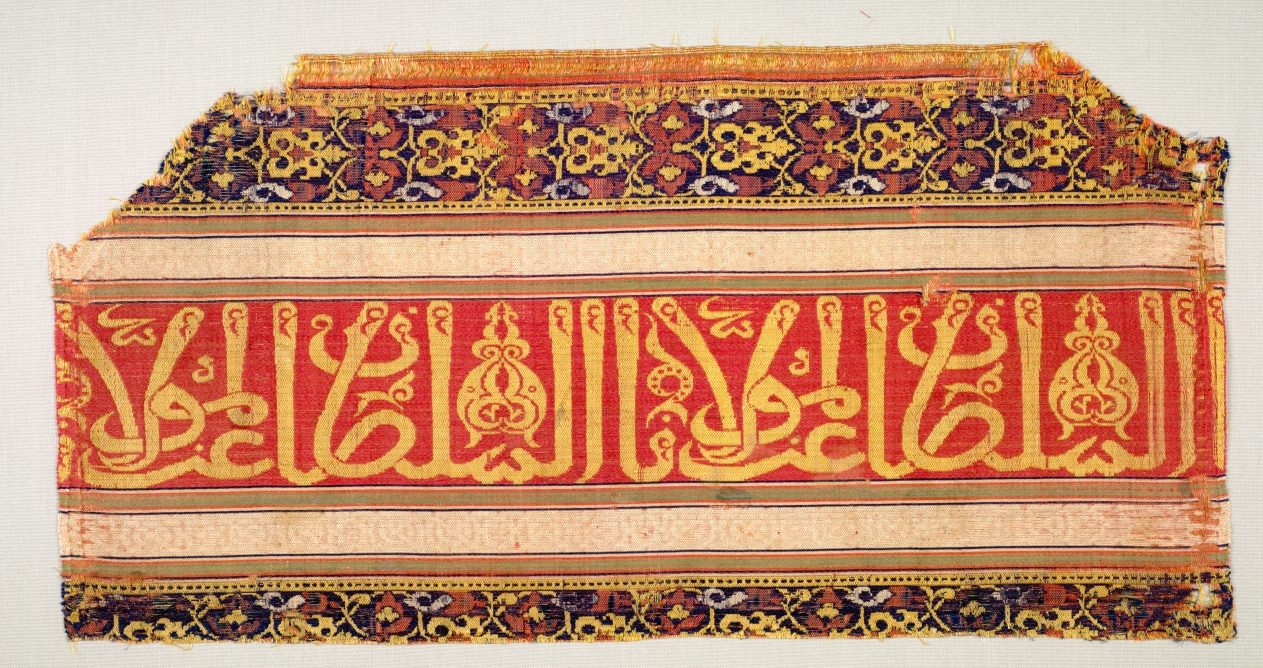
Striped Silk from a Garment (1400s) is in the Cleveland Museum of Art collection.
The work and its context
The museum's open-access catalogue describes the work:
Arabic inscriptions had religious significance to viewers regardless of their legibility. This text repeats "Glory to our Lord the Sultan," a phrase that also enhances the Alhambra Palace walls. For Muslims, Arabic texts symbolized the divine revelation of God’s word to the Prophet Muhammad and recorded in the holy Qur’an; for Spanish Catholics it represented the Holy Land. In striped silks, inscriptions often alternate with interlacing bands and palmettes. Inscribed silks have survived as Catholic church vestments.
Object facts
- Title: Striped Silk from a Garment
- Date: 1400s
- Culture: Spain, Granada, Nasrid period
- Type: Textile
- Technique: silk; lampas weave
- Dimensions: Overall: 54.2 x 27.6 cm (21 5/16 x 10 7/8 in.); Mounted: 61.6 x 27.6 cm (24 1/4 x 10 7/8 in.)
- Collection: T - Islamic
- Department: Textiles
- Accession number: 1940.609
Collection credit
Bequest of James Parmelee
Further reading listed by the museum
- Underhill, Gertrude. "The Bequest of James Parmelee." The Bulletin of the Cleveland Museum of Art 28, no. 2 (February 1941): 15-27
- The Cleveland Museum of Art. The Cleveland Museum of Art Handbook. Cleveland, OH: The Cleveland Museum of Art, 1958.
- The Cleveland Museum of Art. Handbook of the Cleveland Museum of Art/1966. Cleveland, OH: The Cleveland Museum of Art, 1966.
View the collection record
See the museum's photographs and full catalogue entry. Catalogue text is reproduced from the Cleveland Museum of Art's open-access data, with HTML formatting removed. This object and its supplied image are designated CC0.
Sources
More in Fashion & Style
Keep reading