A Sleeping Leopard (1791): Art, History and Details
A Sleeping Leopard at the Cleveland Museum of Art: 1791, Soft-ground etching with roulette work. Explore the work's context, creator attribution and collection history.
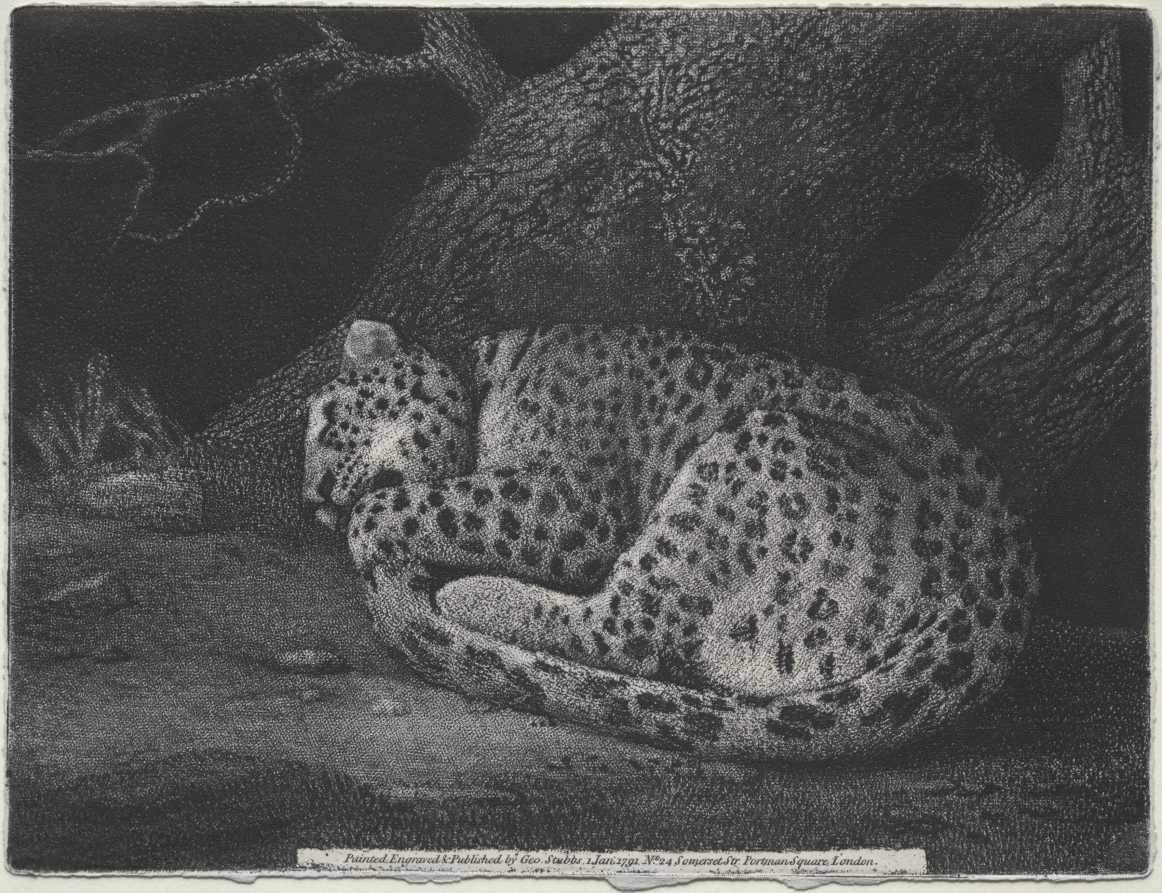
A Sleeping Leopard (1791) is in the Cleveland Museum of Art collection. The museum's creator attribution is George Stubbs (British, 1724–1806).
The work and its context
The museum's open-access catalogue describes the work:
A famed animal painter, George Stubbs studied anatomy and likely had access to one of London’s various menageries, where he could view animals kept as curiosities and brought to England from across the globe. Here, Stubbs used innovative printmaking techniques to capture the roughness of the tree bark, the rocky surface of the ground, and the softness of the leopard’s fur. Stubbs was one of the earliest artists to experiment with soft-ground etching, which allowed him to re-create texture by transferring his image onto a printing plate through an actual drawing.
Object facts
- Title: A Sleeping Leopard
- Date: 1791
- Creator attribution: George Stubbs (British, 1724–1806)
- Culture: England, 18th century
- Type: Print
- Technique: Soft-ground etching with roulette work
- Dimensions: Image and Plate: 18 x 23.7 cm (7 1/16 x 9 5/16 in.); Sheet: 18.4 x 24 cm (7 1/4 x 9 7/16 in.)
- Collection: PR - Mezzotint
- Department: Prints
- Accession number: 1980.90
A detail from the museum
George Stubbs carefully studied the different animals he depicted and even published a book on the anatomy of the horse.
Collection credit
Purchase from the J. H. Wade Fund
Further reading listed by the museum
- Lee, Sherman E. “The Year in Review for 1980.” The Bulletin of the Cleveland Museum of Art 68, no. 6 (June 1981): 163–219.
View the collection record
See the museum's photographs and full catalogue entry. Catalogue text is reproduced from the Cleveland Museum of Art's open-access data, with HTML formatting removed. This object and its supplied image are designated CC0.
Sources
More in Lifestyle
Keep reading