Achala, King of the Wrathful Ones (early 1200s): Art, History and Details
Achala, King of the Wrathful Ones at the Cleveland Museum of Art: early 1200s, Thangka, silk tapestry with pearls. Explore the work's context, creator attribution and collection history.
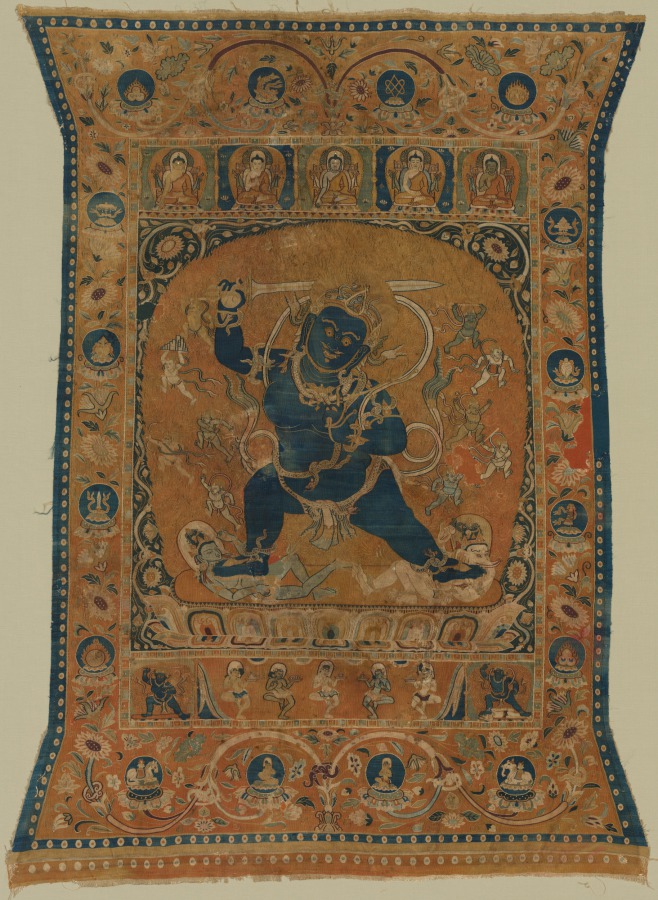
Achala, King of the Wrathful Ones (early 1200s) is in the Cleveland Museum of Art collection.
The work and its context
The museum's open-access catalogue describes the work:
The powerful blue body of Achala, meaning “immovable,” dominates the composition. He holds a sword to cut through ignorance and a noose for catching illusions that plague the path to enlightenment. Small personifications of furious destroyers of illusion (maya) emanate from him on either side, each with his own weapon. This image expresses what advanced practitioners would visualize in meditation rituals, as explained in Buddhist texts called tantras. Woven with a sophistication matched only by products of the Hangzhou looms, this devotional tapestry made its way to Khara-Khoto, capital of the Tangut Empire located in present-day Mongolia and Central Asia, where tantric Buddhism was prevalent.
Object facts
- Title: Achala, King of the Wrathful Ones
- Date: early 1200s
- Culture: China, Zhejiang Province, probably Hangzhou
- Type: Textile
- Technique: Thangka, silk tapestry with pearls
- Dimensions: Overall: 100.6 x 74.3 cm (39 5/8 x 29 1/4 in.); Mounted: 111.1 x 83.8 x 7 cm (43 3/4 x 33 x 2 3/4 in.)
- Collection: Textiles
- Department: Textiles
- Accession number: 1992.72
A detail from the museum
The elephant-headed figure under his left foot is a demonic divinity, a yaksha, who creates obstacles to enlightenment.
Collection credit
Purchase from the J. H. Wade Fund
Further reading listed by the museum
- Turner, Evan H. "The Year in Review for 1992." The Bulletin of the Cleveland Museum of Art 80, no. 2 (1993): 38–79.
- Wardwell, Anne E. "The "Kesi Thangka" of Vighnāntaka." The Bulletin of the Cleveland Museum of Art 80, no. 4 (1993): 136–39.
- "1993 Annual Report." The Bulletin of the Cleveland Museum of Art 81, no. 6 (1994): 143–218.
View the collection record
See the museum's photographs and full catalogue entry. Catalogue text is reproduced from the Cleveland Museum of Art's open-access data, with HTML formatting removed. This object and its supplied image are designated CC0.
Sources
More in Lifestyle
Keep reading