Alarums and Excursions (1899): Art, History and Details
Alarums and Excursions at the Cleveland Museum of Art: 1899, brush and black and gray wash, with white gouache, over graphite, framing lines in pen and black ink. Explore the work's context, creator attribution and collection history.
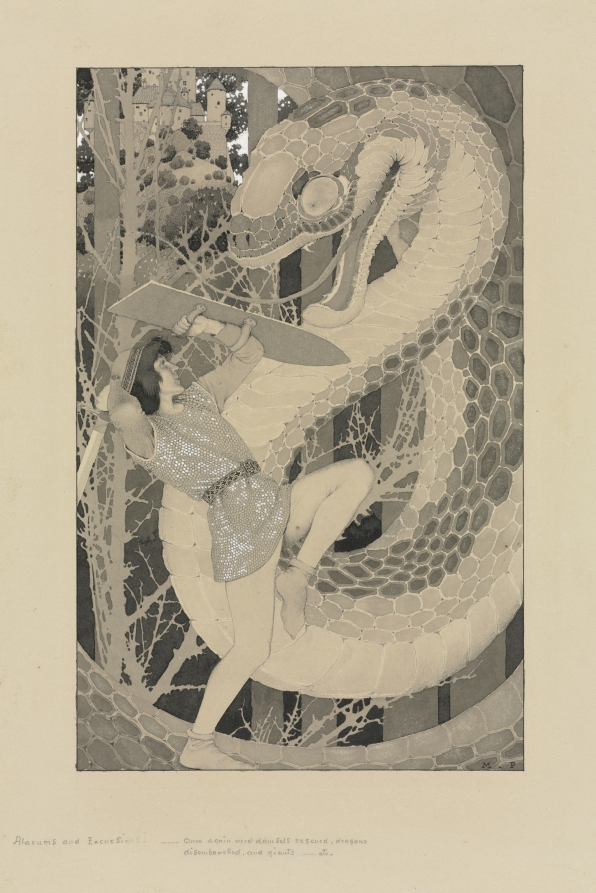
Alarums and Excursions (1899) is in the Cleveland Museum of Art collection. The museum's creator attribution is Maxfield Parrish (American, 1870–1966).
The work and its context
The museum's open-access catalogue describes the work:
Alarums and Excursions is one of nineteen illustrations the young Maxfield Parrish created for Kenneth Grahame’s The Golden Age, a children’s book published in 1899. In the chapter Alarums accompanies, the narrator persuades a friend to join him in a make-believe of Arthurian legends. Parrish depicted one of the boys in the midst of their playful fantasy, as he prepares to strike an enormous, coiled serpent. Parrish rendered the scene in crisp detail, using flat, delicate washes of monochrome ink, strong linear contours, and scintillating pricks of white gouache on the boy’s chainmail. Parrish’s designs found mainstream success in a variety of print media, making him one of the best-known illustrators of the 20th century.
Object facts
- Title: Alarums and Excursions
- Date: 1899
- Creator attribution: Maxfield Parrish (American, 1870–1966)
- Culture: America
- Type: Drawing
- Technique: brush and black and gray wash, with white gouache, over graphite, framing lines in pen and black ink
- Dimensions: Image: 27.9 x 17.7 cm (11 x 6 15/16 in.); Sheet: 37.5 x 24.8 cm (14 3/4 x 9 3/4 in.)
- Collection: DR - American 19th Century
- Department: Drawings
- Accession number: 1940.723
A detail from the museum
Parrish employs a technique called sgraffito (“to scratch”) on the serpent’s tongue, producing its mottled texture by scraping away the upper layer of paper.
Collection credit
Bequest of James Parmelee
Further reading listed by the museum
- Grahame, Kenneth. The Golden Age. John Lane Co.: London & New York [printed], 1899.
- Ludwig, Coy L.. “From Parlor Print to Museum: The Art of Maxfield Parrish.” Art Journal 25, no. 2 (Winter 1965-1966): 143-146.
- Ludwig, Coy L., Diane Casella Hines, Robert Fillie, and James Craig. Maxfield Parrish. New York, NY: Watson-Guptill Publications, 1973.
View the collection record
See the museum's photographs and full catalogue entry. Catalogue text is reproduced from the Cleveland Museum of Art's open-access data, with HTML formatting removed. This object and its supplied image are designated CC0.
Sources
More in Lifestyle
Keep reading