As punishment, the jester’s wife and the Zangi are thrown into fire and the emir’s wife and the mahout are trampled by an elephant, from a Tuti-nama (Tales of a Parrot), Twenty-second Night (c. 1560):
As punishment, the jester’s wife and the Zangi are thrown into fire and the emir’s wife and the mahout are trampled by an elephant, from a Tuti-nama (Tales of a Parrot), Twenty-second Night at the Cleveland Museum of Art: c. 1560, gum tempe
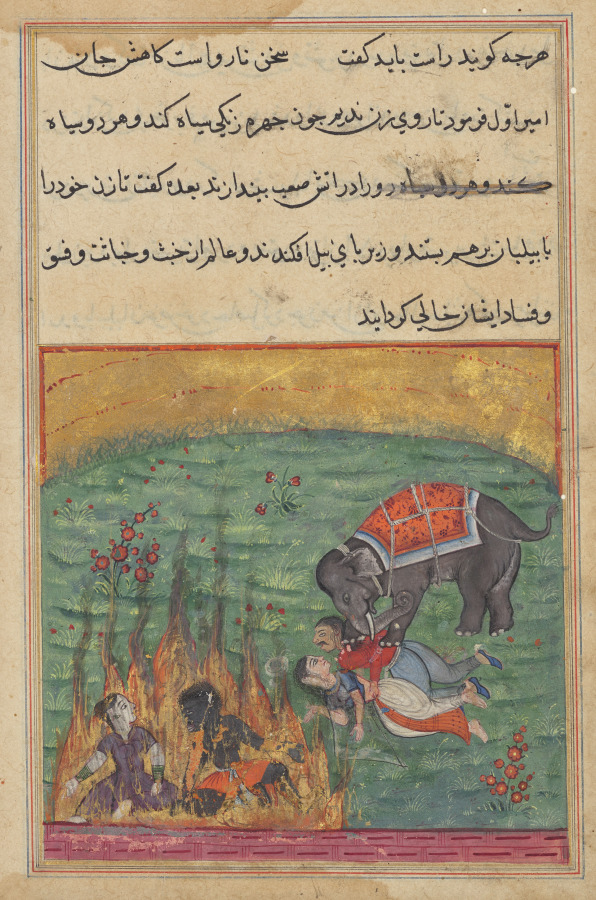
As punishment, the jester’s wife and the Zangi are thrown into fire and the emir’s wife and the mahout are trampled by an elephant, from a Tuti-nama (Tales of a Parrot), Twenty-second Night (c. 1560) is in the Cleveland Museum of Art collection.
The work and its context
The museum's open-access catalogue describes the work:
This painting depicts the closing scene of the tale the parrot tells Khujasta on the twenty-second night. He concludes the story by warning his mistress against committing any acts that would cause her to be laughed at and get her into trouble, like the wife of the emir, who is shown here being trampled to death along with her lover, the elephant driver. While in prison the jester caught them having sex on top of the elephant her lover had ridden up to her window. This brazen transgression made the imprisoned jester laugh so hard that the emir was alerted to the illicit affair. In the lower left the jester’s wife and her African lover, the Zangi, are being burned in punishment for their infidelity.
Object facts
- Title: As punishment, the jester’s wife and the Zangi are thrown into fire and the emir’s wife and the mahout are trampled by an elephant, from a Tuti-nama (Tales of a Parrot), Twenty-second Night
- Date: c. 1560
- Culture: Mughal India, court of Akbar (reigned 1556–1605)
- Type: Painting
- Technique: gum tempera, ink, and gold on paper
- Dimensions: Overall: 20.3 x 14 cm (8 x 5 1/2 in.); Painting only: 10 x 10.1 cm (3 15/16 x 4 in.)
- Collection: Indian Art
- Department: Indian and Southeast Asian Art
- Accession number: 1962.279.158.b
A detail from the museum
This painting shows features of Persian painting that transferred to India in the early Mughal court.
Collection credit
Gift of Mrs. A. Dean Perry
Further reading listed by the museum
- Seyller, John. “Overpainting in the Cleveland T̤ūtīnāma.” Artibus Asiae 52, no. 3/4 (1992): 283-318.
View the collection record
See the museum's photographs and full catalogue entry. Catalogue text is reproduced from the Cleveland Museum of Art's open-access data, with HTML formatting removed. This object and its supplied image are designated CC0.
Sources
More in Lifestyle
Keep reading