Backpack (Bagobo people) (early 1900s): Art, History and Details
Backpack (Bagobo people) at the Cleveland Museum of Art: early 1900s, Handwoven abacá cloth, printed cotton cloth, abacá fiber (braided/plaited cordage), glass beads, metal sequins, metal rings, fiber tassels. Explore the work's context, cr
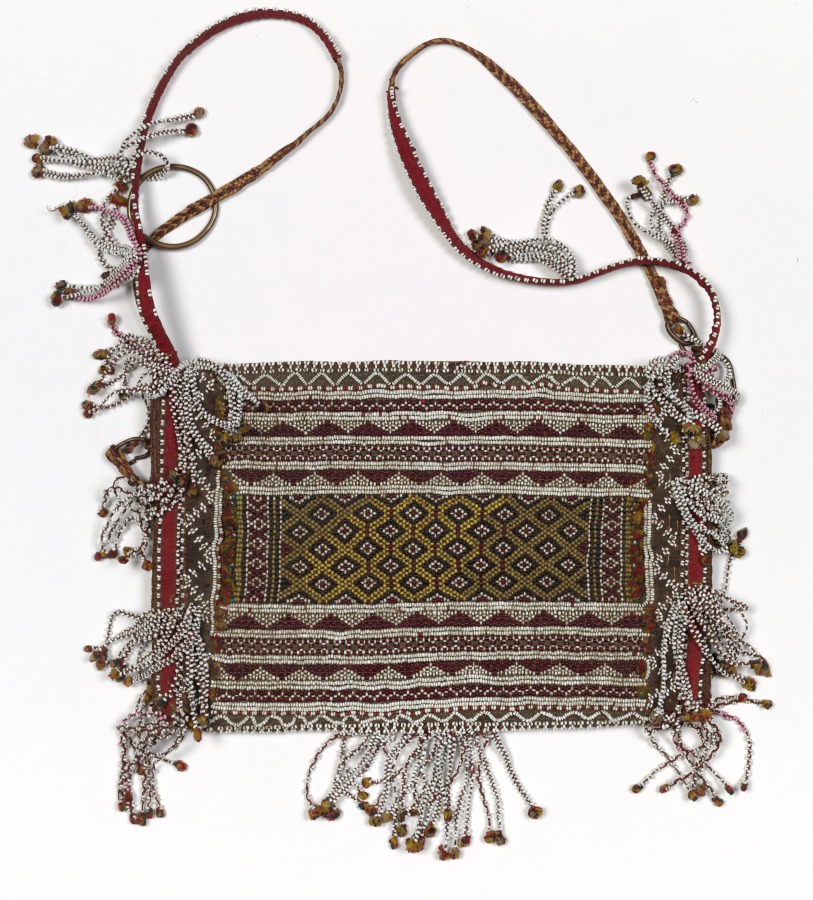
Backpack (Bagobo people) (early 1900s) is in the Cleveland Museum of Art collection.
The work and its context
The museum's open-access catalogue describes the work:
This backpack for men is constructed from a single length of handwoven abacá cloth, woven in a warp-faced plain weave with supplementary weft patterning. The beadwork uses glass beads of various colors arranged in geometric bands and diamond motifs characteristic of the Bagobo people. Two shoulder straps, constructed from braided abacá fibers overlaid with cotton cloth and embellished with beads and metal sequins, are attached through metal rings.
Object facts
- Title: Backpack (Bagobo people)
- Date: early 1900s
- Culture: Philippines
- Type: Textile
- Technique: Handwoven abacá cloth, printed cotton cloth, abacá fiber (braided/plaited cordage), glass beads, metal sequins, metal rings, fiber tassels
- Dimensions: Overall: 24.1 x 35.6 cm (9 1/2 x 14 in.)
- Collection: Textiles
- Department: Textiles
- Accession number: 1917.770
A detail from the museum
Ethnographic photographs document backpacks like this one being worn by Bagobo men in ceremonial or formal contexts.
Collection credit
Gift of Mrs. G. Field Adams
View the collection record
See the museum's photographs and full catalogue entry. Catalogue text is reproduced from the Cleveland Museum of Art's open-access data, with HTML formatting removed. This object and its supplied image are designated CC0.
Sources
More in Lifestyle
Keep reading