Ballgame Hip Protector (Yoke) (600–900): Art, History and Details
Ballgame Hip Protector (Yoke) at the Cleveland Museum of Art: 600–900, greenstone, pigment. Explore the work's context, creator attribution and collection history.
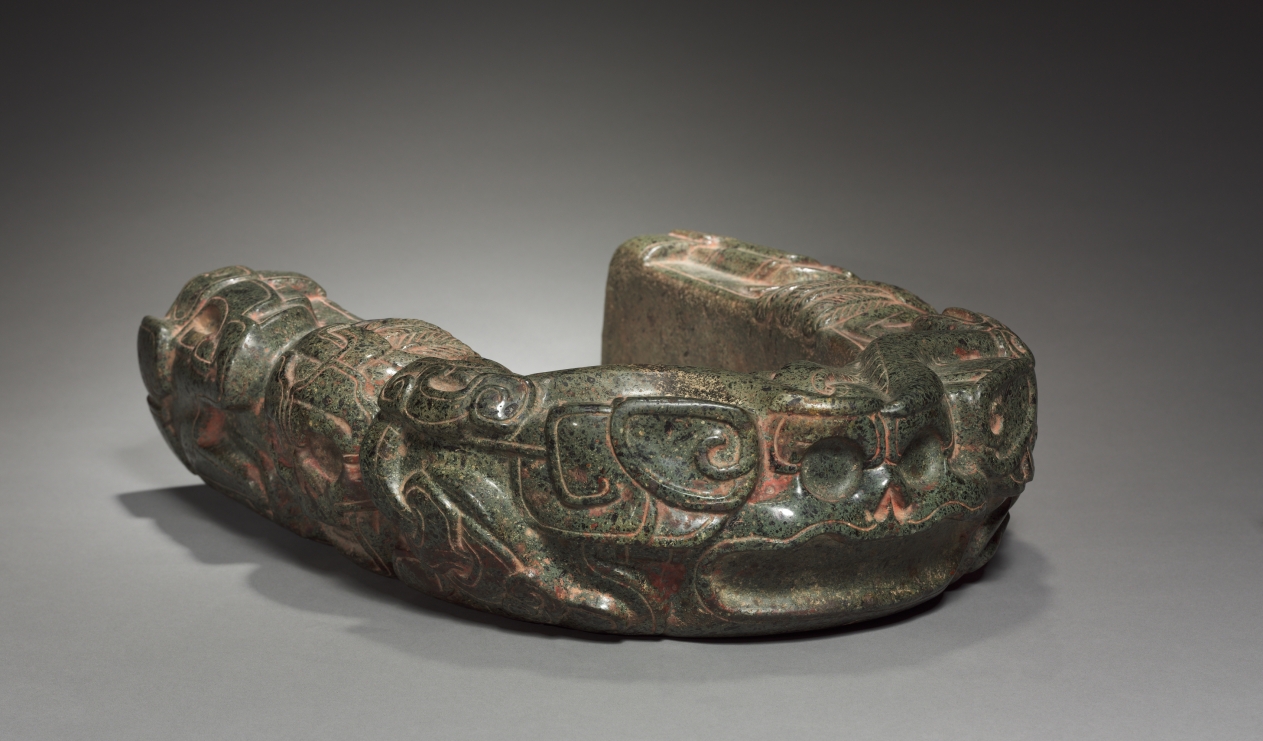
Ballgame Hip Protector (Yoke) (600–900) is in the Cleveland Museum of Art collection.
The work and its context
The museum's open-access catalogue describes the work:
U-shaped ballgame sculptures imitate the shape of belt-like protectors, perhaps made of wood and padding, worn to shield ballplayers from injury when they returned the solid rubber ball from their hips. This fine example embodies a major theme of the ballgame: the connection between fertility and death. It is made of greenstone, a precious material that through its color symbolizes the lush burgeoning of nature after the rainy season. The imagery, however, is menacing: a monstrous head snarls from the curve, and human skulls appear on the sides.
Object facts
- Title: Ballgame Hip Protector (Yoke)
- Date: 600–900
- Culture: Mexico, Gulf Coast, Classic Veracruz style (600-1100)
- Type: Sculpture
- Technique: greenstone, pigment
- Dimensions: Overall: 41.5 x 37.5 x 11 cm (16 5/16 x 14 3/4 x 4 5/16 in.)
- Collection: AA - Mesoamerica
- Department: Art of the Americas
- Accession number: 1973.213
A detail from the museum
The ballgame was a team sport played on specially constructed rectangular courts and involved striking a large solid rubber ball without using your hands.
Collection credit
Leonard C. Hanna Jr. Fund
Further reading listed by the museum
- Spinden, Ellen S. "The Place of Tajin in Totonac Archaeology." American Anthropologist, New Series, 35, no. 2 (1933)
- Palacios, Enrique Juan. Arqueología de México: culturas arcaica y tolteca (Ilustraciones novedosas, en parte procedentes de piezas de la colección del autor). México: Imprenta Mundial, 1937.
- Ekholm, Gordon. " Is American Indian Culture Asiatic?" Natural History (1950).
View the collection record
See the museum's photographs and full catalogue entry. Catalogue text is reproduced from the Cleveland Museum of Art's open-access data, with HTML formatting removed. This object and its supplied image are designated CC0.
Sources
More in Lifestyle
Keep reading