Basin with Feathered Serpent (400–550 CE): Art, History and Details
Basin with Feathered Serpent at the Cleveland Museum of Art: 400–550 CE, earthenware, stucco, pigment. Explore the work's context, creator attribution and collection history.
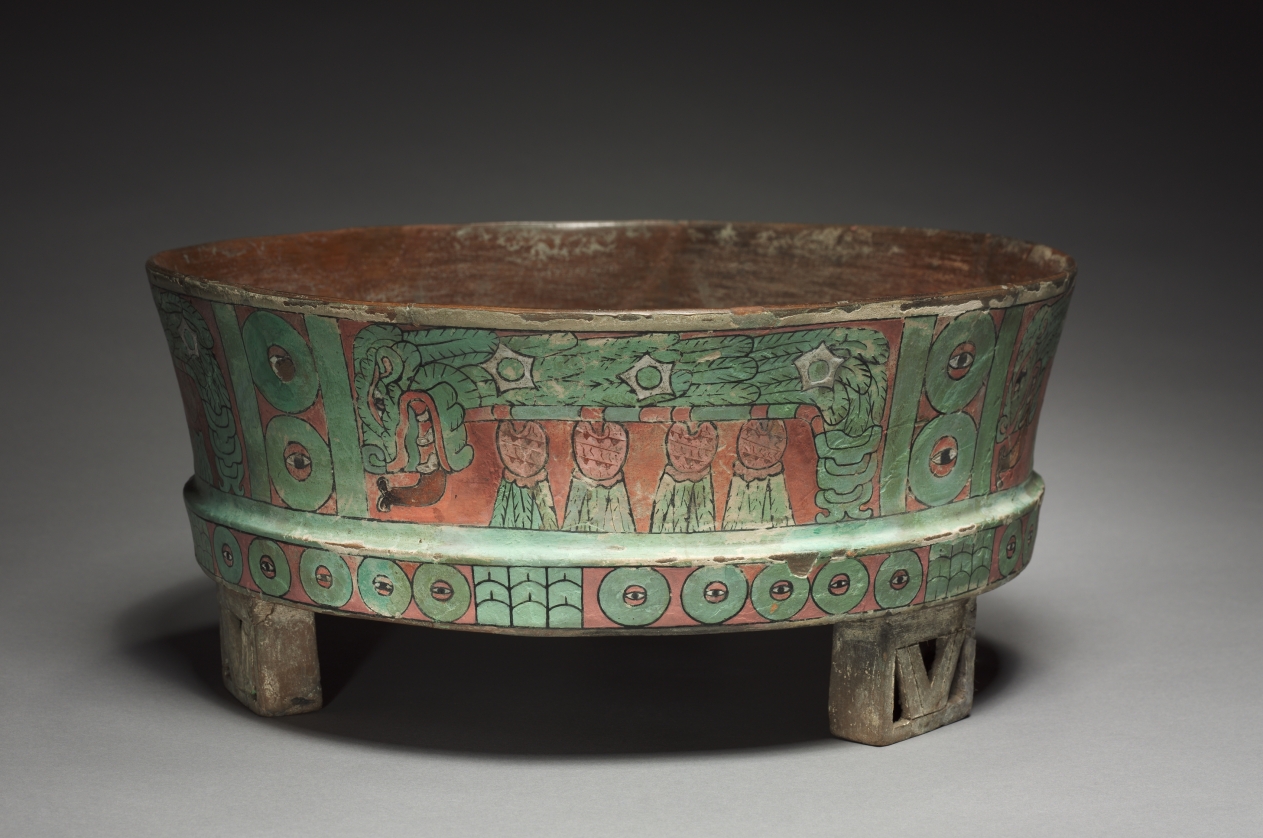
Basin with Feathered Serpent (400–550 CE) is in the Cleveland Museum of Art collection.
The work and its context
The museum's open-access catalogue describes the work:
The serpent covered with the green feathers of the tropical quetzal bird is an image of verdant, bountiful nature and life. It also may be a symbol of rulership, thus linking rulers to cosmic forces and the natural order. Four human hearts lie beneath the serpent on this unusually large basin, suggesting that sacrifice stimulates nature’s fruitfulness.
Object facts
- Title: Basin with Feathered Serpent
- Date: 400–550 CE
- Culture: Central Mexico, Teotihuacán style, Classic period
- Type: Ceramic
- Technique: earthenware, stucco, pigment
- Dimensions: Diameter: 16.2 x 34.5 x 34.5 cm (6 3/8 x 13 9/16 x 13 9/16 in.)
- Collection: AA - Mesoamerica
- Department: Art of the Americas
- Accession number: 1965.20
Collection credit
Purchase from the J. H. Wade Fund
Further reading listed by the museum
- Schaafsma, Polly. "Quetzalcoatl and the Horned and Feathered Serpent of the Southwest." In The Road to Aztlan: Art from a Mythic Homeland. Virginia M. Fields, and Victor Zamudio-Taylor, eds., 138-149. Los Angeles: Los Angeles County Museum of Art, 2001.
- Conides, Cynthia. Made to Order: Painted Ceramics of Ancient Teotihuacan. Norman : University of Oklahoma Press, 2018.
View the collection record
See the museum's photographs and full catalogue entry. Catalogue text is reproduced from the Cleveland Museum of Art's open-access data, with HTML formatting removed. This object and its supplied image are designated CC0.
Sources
More in Lifestyle
Keep reading