Beaker (1100–1000 BCE): Art, History and Details
Beaker at the Cleveland Museum of Art: 1100–1000 BCE, gold, low relief repoussé and incised. Explore the work's context, creator attribution and collection history.
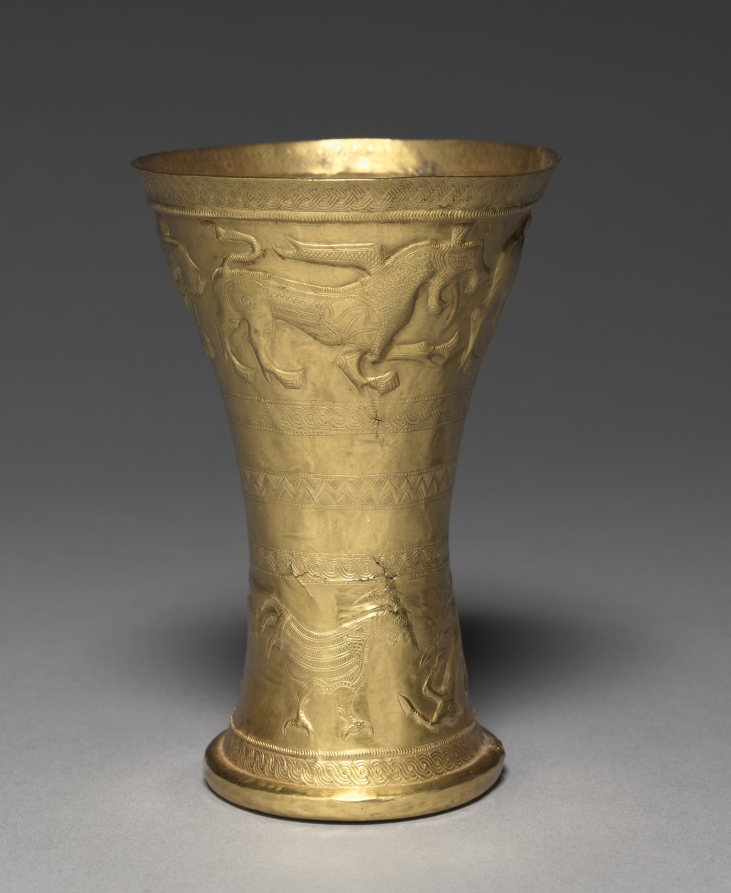
Beaker (1100–1000 BCE) is in the Cleveland Museum of Art collection.
The work and its context
The museum's open-access catalogue describes the work:
The nomadic gold- and silversmiths of Marlik and Amlash were the first masters of precious metalwork in Iran. Their successors were the bronze workers of Luristan and the silversmiths of the Achaemenian and Sasanian empires, whose masterpieces are shown elsewhere in this gallery.
Object facts
- Title: Beaker
- Date: 1100–1000 BCE
- Culture: Iran, Marlik
- Type: Metalwork
- Technique: gold, low relief repoussé and incised
- Dimensions: Overall: 14 x 9.3 cm (5 1/2 x 3 11/16 in.)
- Collection: Near Eastern Art
- Department: Egyptian and Ancient Near Eastern Art
- Accession number: 1965.26
Collection credit
Purchase from the J. H. Wade Fund
Further reading listed by the museum
- The Cleveland Museum of Art. Handbook of the Cleveland Museum of Art/1966. Cleveland, OH: The Cleveland Museum of Art, 1966.
- Stechow, Wolfgang. "Cleveland's Golden Anniversary Acquisitions." Artnews 65, no. 5 (September 1966): 30-64.
- The Cleveland Museum of Art. Handbook of the Cleveland Museum of Art/1969. Cleveland, OH: The Cleveland Museum of Art, 1969.
View the collection record
See the museum's photographs and full catalogue entry. Catalogue text is reproduced from the Cleveland Museum of Art's open-access data, with HTML formatting removed. This object and its supplied image are designated CC0.
Sources
More in Lifestyle
Keep reading