Bidri Pandan with Chevrons (c. 1700): Art, History and Details
Bidri Pandan with Chevrons at the Cleveland Museum of Art: c. 1700, Zinc alloy with silver overlay. Explore the work's context, creator attribution and collection history.
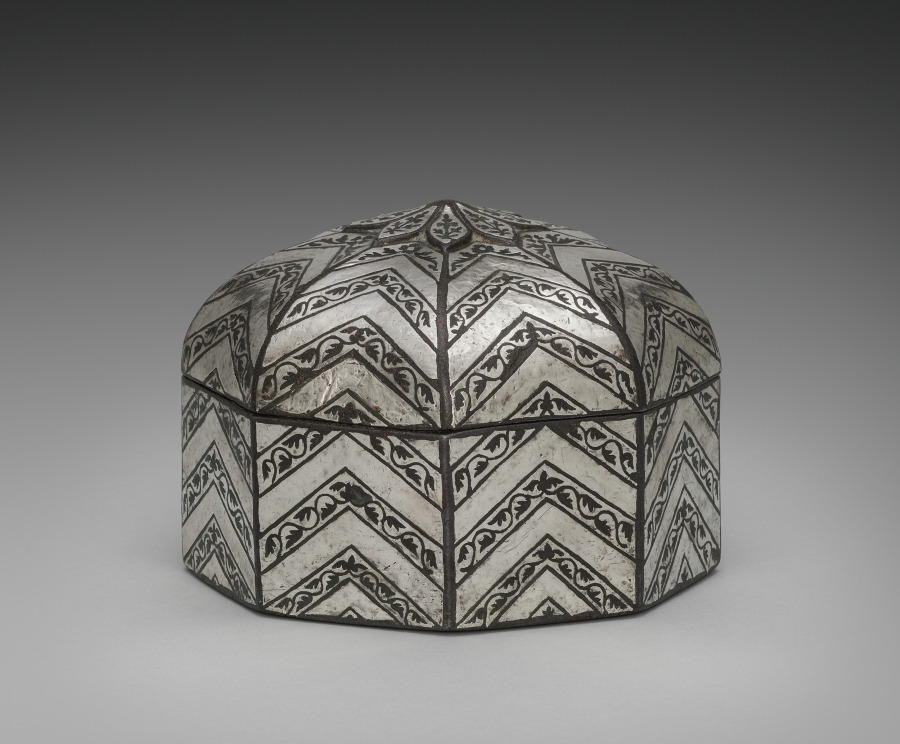
Bidri Pandan with Chevrons (c. 1700) is in the Cleveland Museum of Art collection.
The work and its context
The museum's open-access catalogue describes the work:
A pandan is a lidded vessel for serving paan, which has been enjoyed in India for more than two thousand years. Paan is betel or areca nut mixed with lime powder, aromatics such as clove cinnamon, or cardamom, and wrapped in betel leaf. The whole packet is chewed after a meal as a mild stimulant and mouth freshener.
Object facts
- Title: Bidri Pandan with Chevrons
- Date: c. 1700
- Culture: Southwestern India, Deccan, Karnataka, Bidar
- Type: Metalwork
- Technique: Zinc alloy with silver overlay
- Dimensions: Diameter: 15 cm (5 7/8 in.); height: 10.5 cm (4 1/8 in.)
- Collection: Indian Art
- Department: Indian and Southeast Asian Art
- Accession number: 2020.206
A detail from the museum
The lime powder in paan functioned as an ancient antacid after meals.
Collection credit
Severance and Greta Millikin Purchase Fund
Further reading listed by the museum
- Zebrowski, Mark. Gold, Silver & Bronze from Mughal India. London: Alexandria Press in association with Laurence King, 1997.
View the collection record
See the museum's photographs and full catalogue entry. Catalogue text is reproduced from the Cleveland Museum of Art's open-access data, with HTML formatting removed. This object and its supplied image are designated CC0.
Sources
More in Lifestyle
Keep reading