Bird Effigy Pipe Fragment (400 BCE–100 CE): Art, History and Details
Bird Effigy Pipe Fragment at the Cleveland Museum of Art: 400 BCE–100 CE, sandstone. Explore the work's context, creator attribution and collection history.
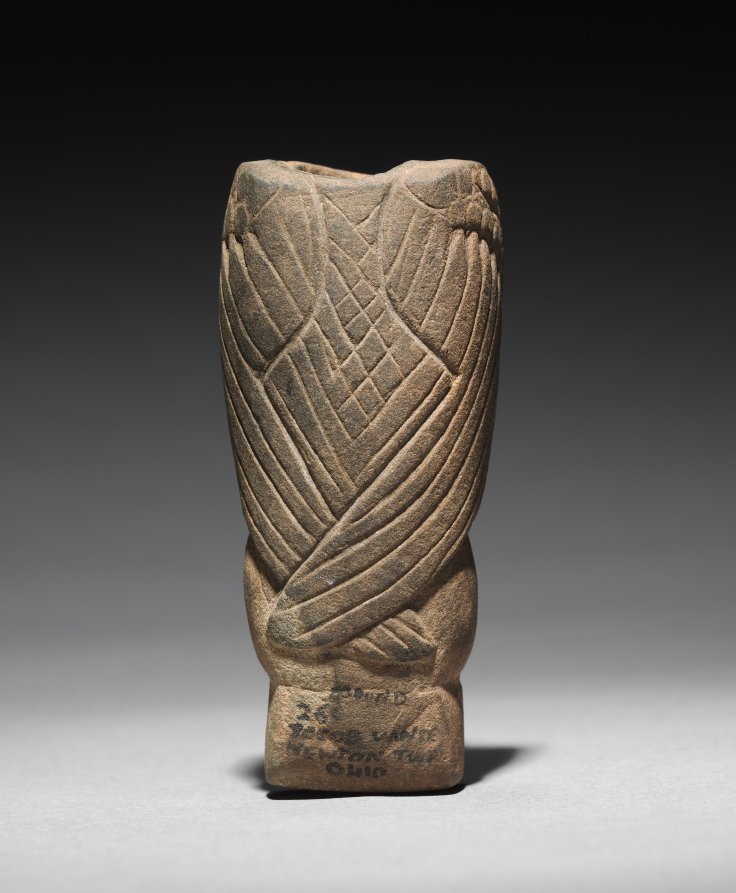
Bird Effigy Pipe Fragment (400 BCE–100 CE) is in the Cleveland Museum of Art collection.
The work and its context
The museum's open-access catalogue describes the work:
The modest appearance of this small bird-effigy pipe, its head now lost, is misleading—the carving is fine and imagery, complex. The upper part takes the form of a bird’s body, the wings folded over the back. The section beneath the bird’s breast, intact but difficult to read, may depict a human torso with a pronounced navel and upraised forearms and hands, the palms facing outward. If so, one creature could be carrying or transforming into the other. The pipe was created by an artist of the ancient Adena people of southern Ohio. Smoke traveled through an interior channel to the mouthpiece, a small hole on the underside.
Object facts
- Title: Bird Effigy Pipe Fragment
- Date: 400 BCE–100 CE
- Culture: Native North America, Adena people, Vance Mound, Newton Township, Licking County, Ohio
- Type: Sculpture
- Technique: sandstone
- Dimensions: Overall: 6.6 x 2.5 x 2.5 cm (2 5/8 x 1 x 1 in.)
- Collection: AA - Native North America
- Department: Art of the Americas
- Accession number: 1963.272
Collection credit
Gift of Arthur George Smith
Further reading listed by the museum
- Townsend, Earl C. "Hopewell or Adena Effigy Pipes." Central States Archaeological Journal 1, no. 2 (1954).
- Smith, Arthur George. "An Adena Effigy Pipe," The Ohio Archaeologist Vol. 14, no. 1 (1964).
View the collection record
See the museum's photographs and full catalogue entry. Catalogue text is reproduced from the Cleveland Museum of Art's open-access data, with HTML formatting removed. This object and its supplied image are designated CC0.
Sources
More in Lifestyle
Keep reading