Mirror (c. 470–460 BCE): Art, History and Details
Mirror at the Cleveland Museum of Art: c. 470–460 BCE, bronze. Explore the work's context, creator attribution and collection history.
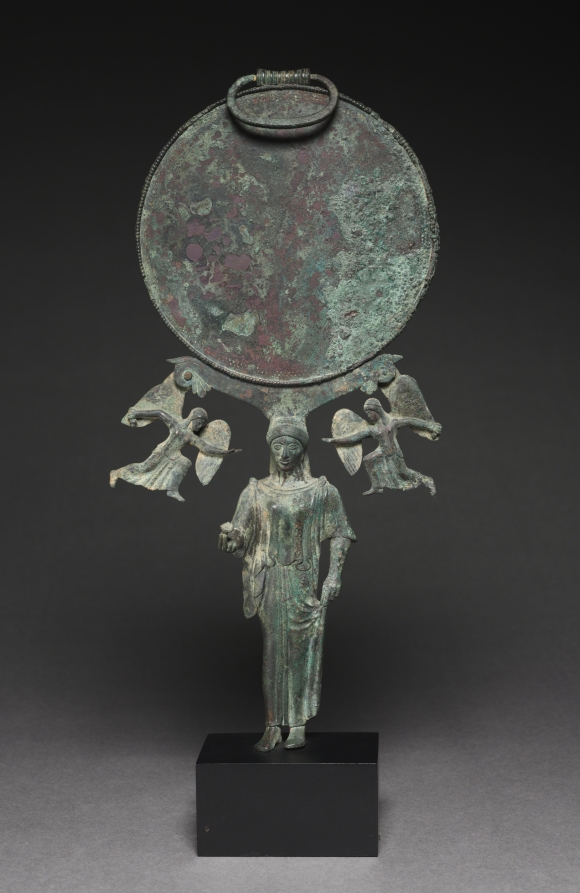
Mirror (c. 470–460 BCE) is in the Cleveland Museum of Art collection.
The work and its context
The museum's open-access catalogue describes the work:
Named for their figured handles, Greek caryatid mirrors may derive from similar types created in ancient Egypt many centuries earlier (like CMA 1983.196). Greek caryatid handles typically take the form of a beautiful, draped woman like this one, whether mortal or divine (perhaps the love goddess Aphrodite). Often, she holds a small offering, here a flower. The small, winged women (Nikai) flanking her are unusual among such mirrors, which often feature Erotes in this position. In antiquity, the unadorned disk would have been highly polished and reflective, and the figure would have stood on an integrated base.
Object facts
- Title: Mirror
- Date: c. 470–460 BCE
- Culture: Greece, Sicyon(?)
- Type: Metalwork
- Technique: bronze
- Dimensions: Diameter: 15.3 cm (6 in.); Overall: 38.8 cm (15 1/4 in.)
- Collection: GR - Greek
- Department: Greek and Roman Art
- Accession number: 1950.7
A detail from the museum
The term caryatid from classical architecture refers to the female figure serving as a support.
Collection credit
Purchase from the J. H. Wade Fund
Further reading listed by the museum
- Frankel, Max. Archäologische Zeitung Vol. 37 (1879). Berlin: Deutsches Archäologisches Institut. 1880.
- Michaelis, Adolf, and C. A. M. Fennell. Ancient Marbles in Great Britain. Cambridge: University Press, 1882.
- Dumont, Albert. Les Céramiques de la Grèce propre. Paris: Firmin Didot, 1889.
View the collection record
See the museum's photographs and full catalogue entry. Catalogue text is reproduced from the Cleveland Museum of Art's open-access data, with HTML formatting removed. This object and its supplied image are designated CC0.
Sources
More in Lifestyle
Keep reading