Head of Alexander the Great (c. 300–200 BCE): Art, History and Details
Head of Alexander the Great at the Cleveland Museum of Art: c. 300–200 BCE, marble. Explore the work's context, creator attribution and collection history.
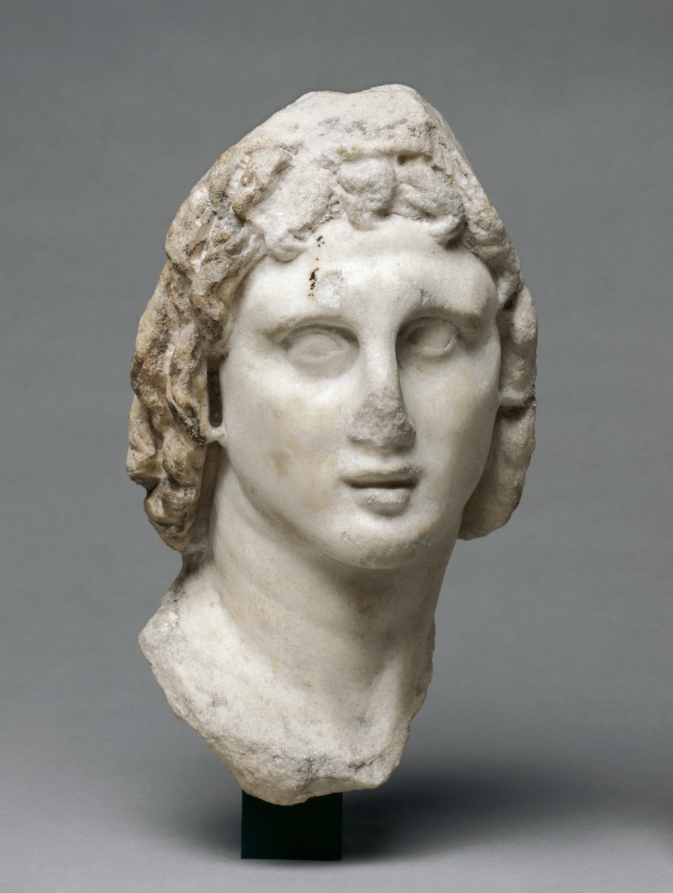
Head of Alexander the Great (c. 300–200 BCE) is in the Cleveland Museum of Art collection.
The work and its context
The museum's open-access catalogue describes the work:
Slightly smaller than life-size, this head of Alexander the Great features a slight turn, tilt, and upward gaze said to have characterized the young conqueror's posture in life. After his death, Alexander was worshiped as a god; posthumous portraits like this one, likely carved in Ptolemaic Egypt, portray him with long hair and youthful, idealized features.
Object facts
- Title: Head of Alexander the Great
- Date: c. 300–200 BCE
- Culture: Greece, Alexandria, Hellenistic
- Type: Sculpture
- Technique: marble
- Dimensions: Overall: 26.5 x 14.5 x 13.8 cm (10 7/16 x 5 11/16 x 5 7/16 in.)
- Collection: GR - Greek
- Department: Greek and Roman Art
- Accession number: 1927.209
A detail from the museum
Portraits of Alexander the Great share his characteristic anastole hairstyle, parted off-center and swept back from the forehead.
Collection credit
Gift of Mrs. Ralph King
Further reading listed by the museum
- Bieber, Margarete. 1961. The Sculpture of the Hellenistic Age. Rev. ed. New York: Columbia University Press.
- R. H. “A Portrait of Alexander.” The Bulletin of the Cleveland Museum of Art 15, no. 1 (January 1928): 6–7.
- The Cleveland Museum of Art. The Cleveland Museum of Art Handbook. Cleveland, OH: The Cleveland Museum of Art, 1958.
View the collection record
See the museum's photographs and full catalogue entry. Catalogue text is reproduced from the Cleveland Museum of Art's open-access data, with HTML formatting removed. This object and its supplied image are designated CC0.
Sources
More in Lifestyle
Keep reading