Black-Topped Beaker (4500–3000 BCE): Art, History and Details
Black-Topped Beaker at the Cleveland Museum of Art: 4500–3000 BCE, Nile silt pottery. Explore the work's context, creator attribution and collection history.
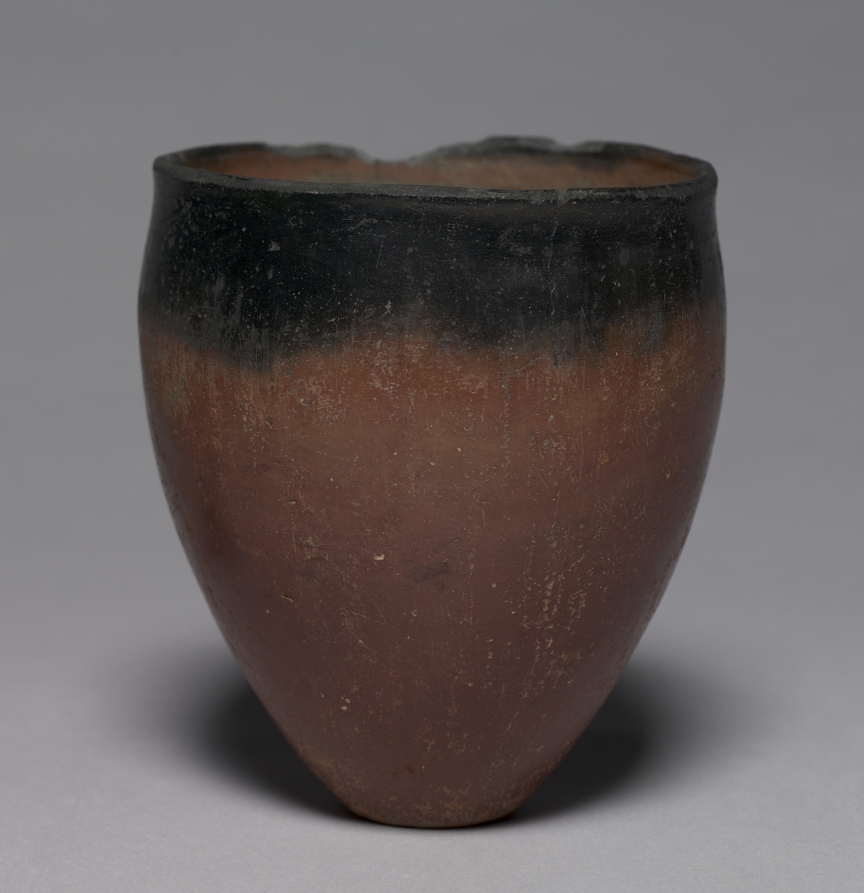
Black-Topped Beaker (4500–3000 BCE) is in the Cleveland Museum of Art collection.
The work and its context
The museum's open-access catalogue describes the work:
Red polished vessels with black rims (known as black-topped red ware or B-ware) were the most common funerary pottery during the early Predynastic Period. The characteristic blackening of the rim was probably achieved by burying the mouth of the pot in the ashes of the kiln. The iron in the exposed part would then fire red while the covered area turned black.
Object facts
- Title: Black-Topped Beaker
- Date: 4500–3000 BCE
- Culture: Egypt, Predynastic (5000–2950 BCE), Naqada I–IIb (3900–3300 BCE)
- Type: Vessels
- Technique: Nile silt pottery
- Dimensions: Diameter: 12 cm (4 3/4 in.); Overall: 14 cm (5 1/2 in.)
- Collection: Egypt - Predynastic
- Department: Egyptian and Ancient Near Eastern Art
- Accession number: 1920.2005
Collection credit
Gift of the John Huntington Art and Polytechnic Trust
Further reading listed by the museum
- Berman, Lawrence M., and Kenneth J. Bohač. Catalogue of Egyptian Art: The Cleveland Museum of Art. Cleveland, OH: Cleveland Museum of Art, 1999
View the collection record
See the museum's photographs and full catalogue entry. Catalogue text is reproduced from the Cleveland Museum of Art's open-access data, with HTML formatting removed. This object and its supplied image are designated CC0.
Sources
More in Lifestyle
Keep reading