Blanket Strip (c. 1900): Art, History and Details
Blanket Strip at the Cleveland Museum of Art: c. 1900, Native-tanned hide, glass beads, metal beads, sinew thread. Explore the work's context, creator attribution and collection history.

Blanket Strip (c. 1900) is in the Cleveland Museum of Art collection.
The work and its context
The museum's open-access catalogue describes the work:
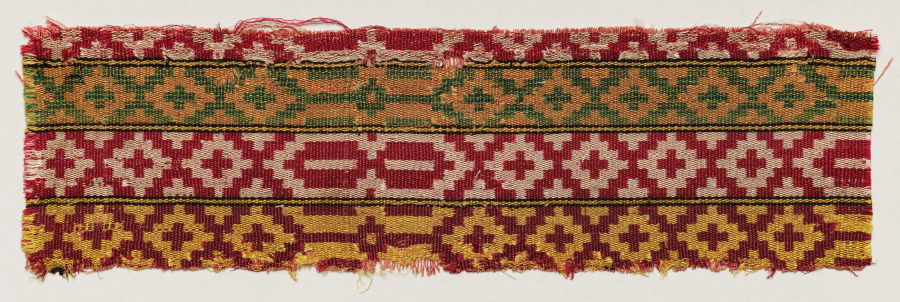
The animal-hide robes basic to Plains attire were often ornamented with quilled or beaded strips, which also were stitched to the blankets that replaced robes. This beaded example carries the cross-in-a-circle motif that symbolizes the world, the four directions, and the sacred center, concepts central to Plains worldviews. In the 1932 words of Black Elk, the Oglala Lakota (Sioux) holy man, “[T]he power of the world always works in circles. . . . The flowering tree was at the center of the hoop, and the circle of the four quarters nourished it. . . . Everything the power of the world does is done in a circle.”
Object facts
- Title: Blanket Strip
- Date: c. 1900
- Culture: Native North America, Plains, Tsitsistas (Cheyenne)
- Type: Leather
- Technique: Native-tanned hide, glass beads, metal beads, sinew thread
- Dimensions: Overall: 163.2 x 13.2 cm (64 1/4 x 5 3/16 in.)
- Collection: T - Native North American
- Department: Textiles
- Accession number: 1937.865
A detail from the museum
This beaded strip was stitched to a hide or a blanket.
Collection credit
Gift of Amelia Elizabeth White
Further reading listed by the museum
- Ruggles, Ruth. "The Amelia Elizabeth White Indian Collection." The Bulletin of the Cleveland Museum of Art 25, no. 2 (February 1938): 25-26, 35.
View the collection record
See the museum's photographs and full catalogue entry. Catalogue text is reproduced from the Cleveland Museum of Art's open-access data, with HTML formatting removed. This object and its supplied image are designated CC0.
Sources
More in Lifestyle
Keep reading