Bodhisattva (700s): Art, History and Details
Bodhisattva at the Cleveland Museum of Art: 700s, bronze. Explore the work's context, creator attribution and collection history.
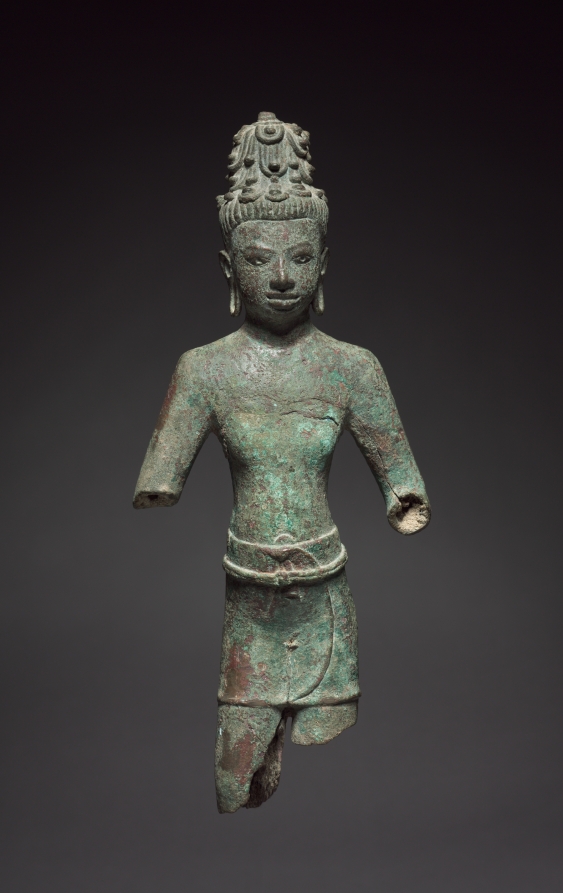
Bodhisattva (700s) is in the Cleveland Museum of Art collection.
The work and its context
The museum's open-access catalogue describes the work:
This rare image survives from the early phase of Buddhist sculpture in Southeast Asia. Made in what is known as the Pra Khon Chai style, it has the characteristic sensitive expression, slender physique, and looped locks of hair. The broken limbs reveal the clay core over which the bronze was cast using the lost-wax method.
Object facts
- Title: Bodhisattva
- Date: 700s
- Culture: Northeastern Thailand, Khorat Plateau, Buriram Province
- Type: Sculpture
- Technique: bronze
- Dimensions: Overall: 31.5 x 13.5 x 5 cm (12 3/8 x 5 5/16 x 1 15/16 in.)
- Collection: Southeast Asian
- Department: Indian and Southeast Asian Art
- Accession number: 2011.152
A detail from the museum
This sculputre was reportedly found as part of a group, some of which are much larger in scale.
Collection credit
Gift of Dr. Norman Zaworski
Further reading listed by the museum
- Sotheby's New York. Indian and Southeast Asian Art. 2 June 1992. Lot 112.
View the collection record
See the museum's photographs and full catalogue entry. Catalogue text is reproduced from the Cleveland Museum of Art's open-access data, with HTML formatting removed. This object and its supplied image are designated CC0.
Sources
More in Lifestyle
Keep reading