Buckle with Animal-Shaped Thorn and Belt Plate (400s CE): Art, History and Details
Buckle with Animal-Shaped Thorn and Belt Plate at the Cleveland Museum of Art: 400s CE, bronze with traces of gilding and garnets. Explore the work's context, creator attribution and collection history.
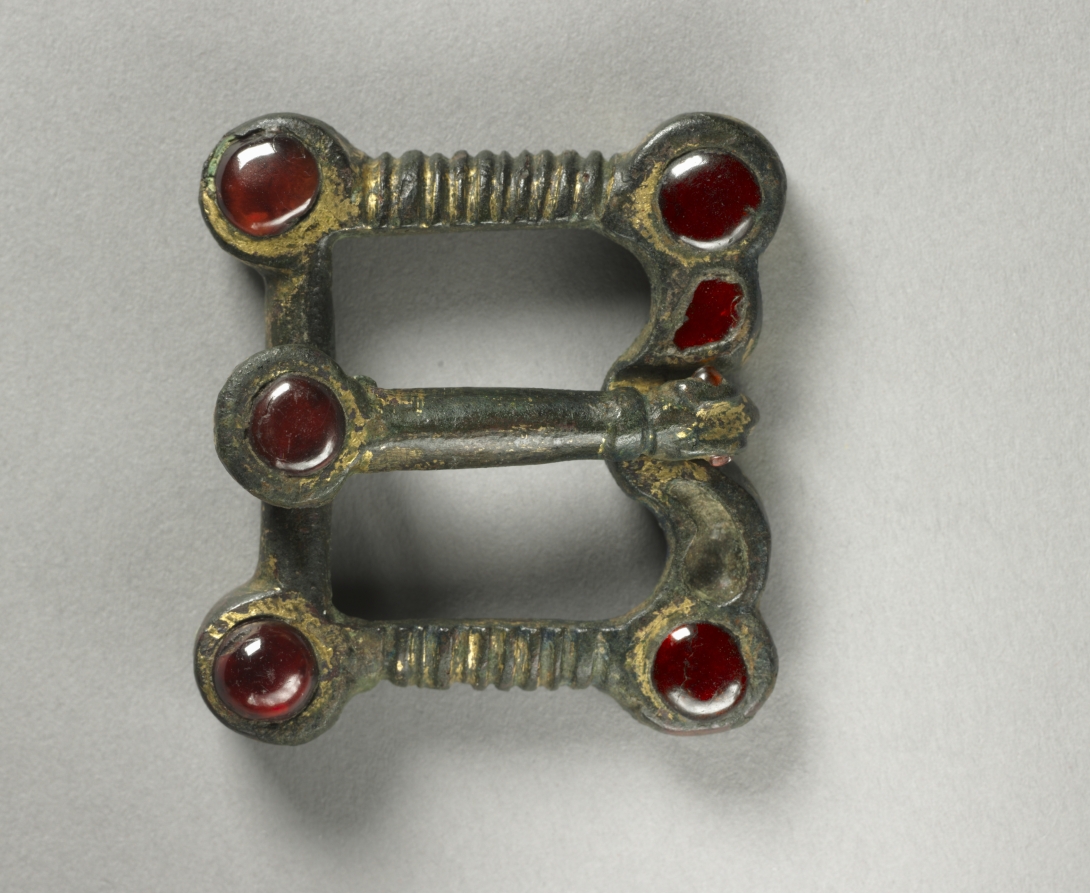
Buckle with Animal-Shaped Thorn and Belt Plate (400s CE) is in the Cleveland Museum of Art collection.
The work and its context
The museum's open-access catalogue describes the work:
Between the AD 200s and the 600s, the European West is characterized by the so-called "barbarian invasions," a term referring to the movement of various Germanic people into the Roman Empire. The period of the great migrations of these Germanic peoples was one of uncertainty and disorder. By the AD 300s, the collapse of Roman military power in the western provinces was increased by the westward movement of the Huns, an especially fierce enemy from the east. The Huns drove before them displaced Germanic tribes—the Visigoths, Ostrogoths, and Lombards—as they advanced deep into the western provinces. These Germanic peoples were composed of many national groups with diverse customs and traditions. Long nomadic, they gradually settled and took to farming, though always preferring maritime commerce and fishing. They were not attracted to the monumental arts of architecture and sculpture until they had long settled an area. By contrast, the tombs of these migratory people were filled with weapons, tools, and jewelry, often magnificently decorated. The art of the Germanic peoples is almost exclusively one of personal adornment—a portable art that followed men and women to their graves.
Object facts
- Title: Buckle with Animal-Shaped Thorn and Belt Plate
- Date: 400s CE
- Culture: Sarmato-Gothic, Migration period, 5th century
- Type: Jewelry
- Technique: bronze with traces of gilding and garnets
- Dimensions: Overall: 4.3 x 4.5 cm (1 11/16 x 1 3/4 in.)
- Collection: MED - Migration Period
- Department: Medieval Art
- Accession number: 1981.9
A detail from the museum
During this time it was popular to wear gold inlaid with precious stones.
Collection credit
In memory of William M. Milliken
Further reading listed by the museum
- Lee, Sherman E. “The Year in Review for 1981.” The Bulletin of the Cleveland Museum of Art 69, no. 2 (February 1982): 39–82.
View the collection record
See the museum's photographs and full catalogue entry. Catalogue text is reproduced from the Cleveland Museum of Art's open-access data, with HTML formatting removed. This object and its supplied image are designated CC0.
Sources
More in Lifestyle
Keep reading