Butterfield Sundial (1700s): Art, History and Details
Butterfield Sundial at the Cleveland Museum of Art: 1700s, silver. Explore the work's context, creator attribution and collection history.
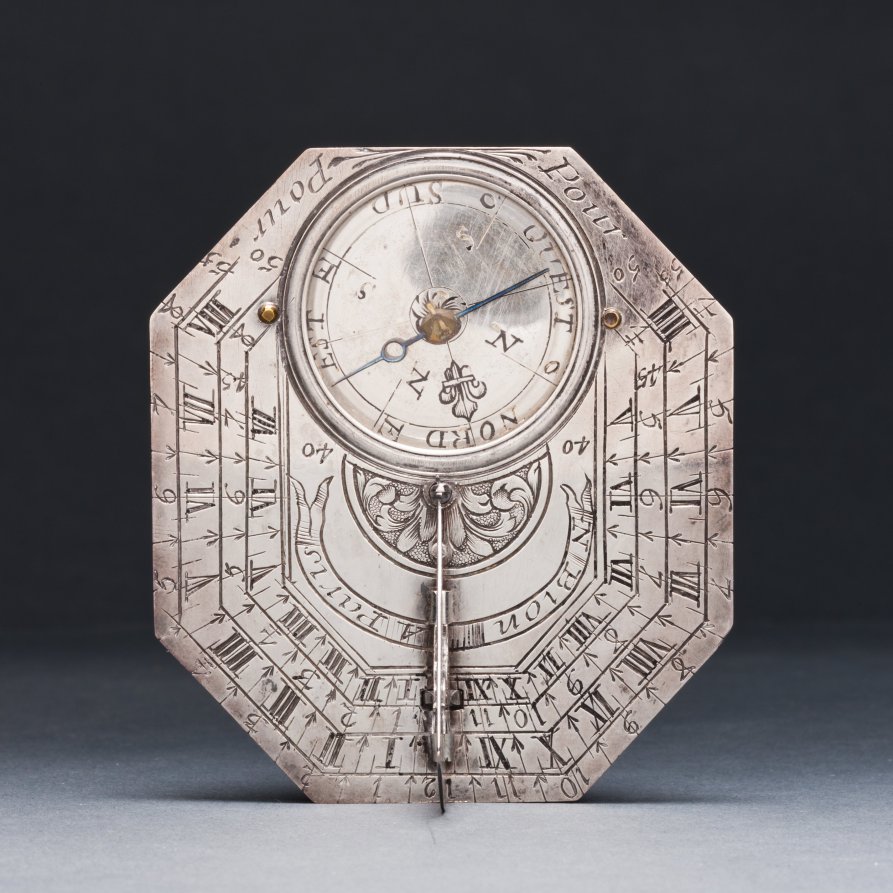
Butterfield Sundial (1700s) is in the Cleveland Museum of Art collection.
The work and its context
The museum's open-access catalogue describes the work:
Butterfield-type sundials are characterized by their adjustable gnomons, metal flaps that cast a shadow on the dial’s face to indicate the hour, and geographical indices. This sundial has a scale adjustable between latitudes of 40° to 60° north. The latitudes of 26 European towns are engraved on its back for quick reference. With an intricately engraved silver face, it would have functioned as a fashionable traveler’s accessory.
Object facts
- Title: Butterfield Sundial
- Date: 1700s
- Culture: France
- Type: Silver
- Technique: silver
- Dimensions: Overall: 7.7 x 7.4 cm (3 1/16 x 2 15/16 in.)
- Collection: Decorative Arts
- Department: Decorative Art and Design
- Accession number: 1942.490
A detail from the museum
Butterfield-style sundials were named after Micheal Butterfield, an English scientific and mathematical instrument maker who worked in Paris between 1674 and 1724.
Collection credit
Gift of Henry W. Kent
View the collection record
See the museum's photographs and full catalogue entry. Catalogue text is reproduced from the Cleveland Museum of Art's open-access data, with HTML formatting removed. This object and its supplied image are designated CC0.
Sources
More in Lifestyle
Keep reading