Calligraphy in Semi-Cursive Style (xing-caoshu) (c. 1660–1709): Art, History and Details
Calligraphy in Semi-Cursive Style (xing-caoshu) at the Cleveland Museum of Art: c. 1660–1709, hanging scroll; ink on paper. Explore the work's context, creator attribution and collection history.
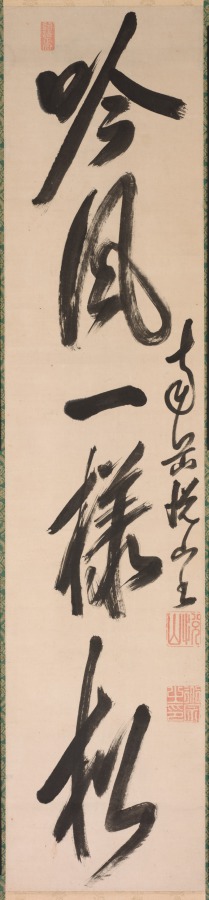
Calligraphy in Semi-Cursive Style (xing-caoshu) (c. 1660–1709) is in the Cleveland Museum of Art collection. The museum's creator attribution is Yueshan Daozong (Chinese, 1629–1709).
The work and its context
The museum's open-access catalogue describes the work:
This bold calligraphy written by Yueshan, an Ōbaku school monk, consists of five characters tentatively translated as “Pine trees singing in the wind.” The line is from Cold Mountain Poems (Hanshan shi). Cold Mountain is the pen name (hao) of the poet monk Han Shan, as well as the name of a place. In one poem Han describes getting lost on the road to Cold Mountain, perhaps an allusion to the search for religious enlightenment.
Object facts
- Title: Calligraphy in Semi-Cursive Style (xing-caoshu)
- Date: c. 1660–1709
- Creator attribution: Yueshan Daozong (Chinese, 1629–1709)
- Culture: China, Qing dynasty (1644-1911)
- Type: Calligraphy
- Technique: hanging scroll; ink on paper
- Dimensions: Painting only: 128.9 x 29 cm (50 3/4 x 11 7/16 in.); Overall with knobs: 179 x 36.4 cm (70 1/2 x 14 5/16 in.)
- Collection: ASIAN - Hanging scroll
- Department: Chinese Art
- Accession number: 2003.354
A detail from the museum
The Ōbaku school of Chan (Zen in Japanese) Buddhism was founded in Japan by Chinese monks in the 1600s. The monk Yueshan emigrated from the Chinese province of Fujian to serve as priest and later abbot at Manpukuji, the headquarters of the Ōbaku school in Japan.
Collection credit
Gift of Mr. and Mrs. Robert T. Gow
Further reading listed by the museum
- Chang, Willow Hai. Song of Life: Chinese Art from the Gow Family Collection. Naples, FL: Naples Museum of Art, 2000.
- Yu, Jing 余靜. “Introduction of Huangbo Calligraphy and Paintings in the Cleveland Museum of Art Collection in the United States = 美國克利夫蘭藝術博物館所藏黃檗書畫譯介.” Research on Fujian Merchant Culture: Special Issue on Huangbo (Ōbaku) Studies 闽商文化研究 黄檗学 特刊(黄檗艺术号) 0105 (2023): 49–53.
View the collection record
See the museum's photographs and full catalogue entry. Catalogue text is reproduced from the Cleveland Museum of Art's open-access data, with HTML formatting removed. This object and its supplied image are designated CC0.
Sources
More in Lifestyle
Keep reading
Related stories