Card Table (c. 1820): Art, History and Details
Card Table at the Cleveland Museum of Art: c. 1820, mahogany with curly maple and ebony veneers, brass mounts and inlays, gilding. Explore the work's context, creator attribution and collection history.
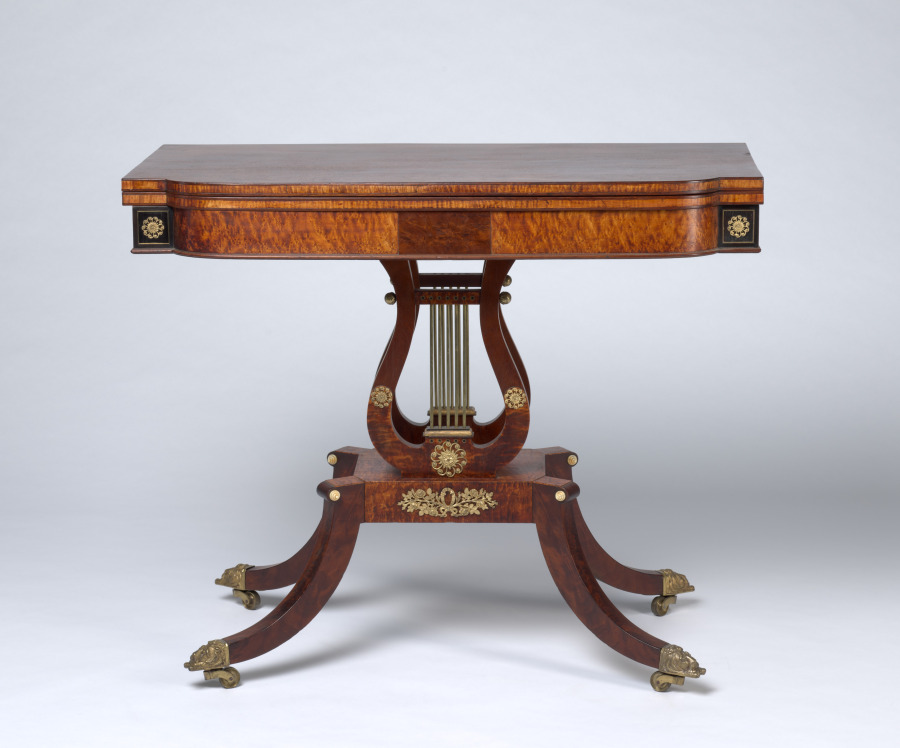
Card Table (c. 1820) is in the Cleveland Museum of Art collection.
The work and its context
The museum's open-access catalogue describes the work:
The lyre-shaped support of this finely made card table marks it as an example of American Federal furniture taking inspiration from classical antiquity for its decoration. When the top was folded closed, such tables were usually placed near a wall. Once the two halves of the top were unfolded, however, the entire upper portion of the table could be rotated until the supporting structure was again beneath the center and the enlarged surface was ready for play. The table was probably made by Michael Bouvier, a French cabinetmaker who worked in Philadelphia and was the first paternal American ancestor of Jacqueline Bouvier Kennedy Onassis.
Object facts
- Title: Card Table
- Date: c. 1820
- Culture: American, Pennsylvania, Philadelphia
- Type: Furniture and woodwork
- Technique: mahogany with curly maple and ebony veneers, brass mounts and inlays, gilding
- Dimensions: Overall: 75 x 90.2 x 45.1 cm (29 1/2 x 35 1/2 x 17 3/4 in.)
- Collection: Furniture
- Department: Decorative Art and Design
- Accession number: 1987.52
Collection credit
John L. Severance Fund
Further reading listed by the museum
- Hawley, Henry. “Philadelphia Tables with Lyre Supports.” The Bulletin of the Cleveland Museum of Art 75, no. 1 (January 1988): 2–27.
View the collection record
See the museum's photographs and full catalogue entry. Catalogue text is reproduced from the Cleveland Museum of Art's open-access data, with HTML formatting removed. This object and its supplied image are designated CC0.
Sources
More in Lifestyle
Keep reading
Related stories