Feast Ladle (late 1800s–early 1900s): Art, History and Details
Feast Ladle at the Cleveland Museum of Art: late 1800s–early 1900s, horn, bone, copper, abalone shell inlay. Explore the work's context, creator attribution and collection history.
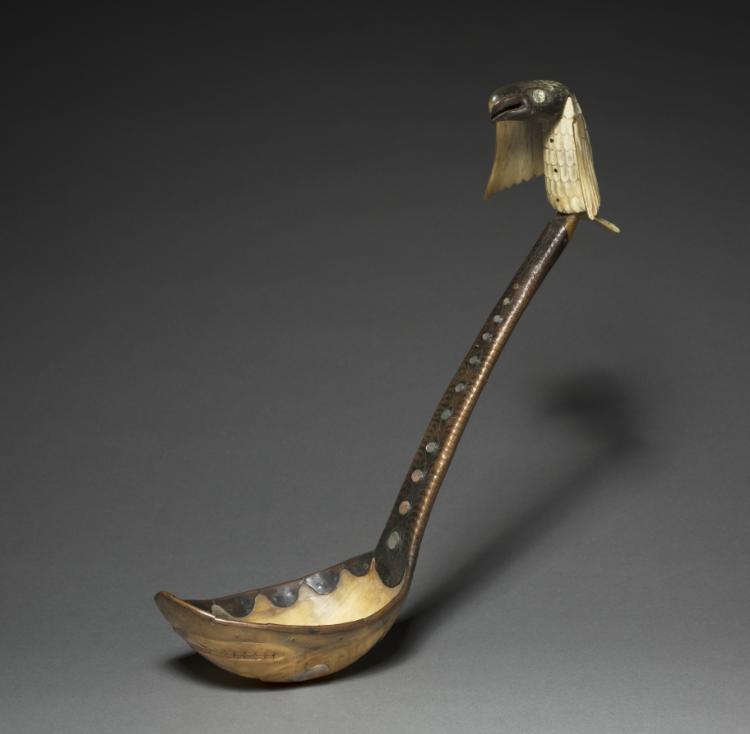
Feast Ladle (late 1800s–early 1900s) is in the Cleveland Museum of Art collection.
The work and its context
The museum's open-access catalogue describes the work:
Elaborate utensils, valuable possessions of Northwest Coast noble clans, were used during potlatch feasts. An imposing eagle hovers, patron-like, over this ladle’s bowl and the bounty it once served; a bear’s head appears on the underside of the bowl. Both may be crests, motifs that, like European heraldry, were exclusive to important families and referred to their histories and rights to control land and resources.
Object facts
- Title: Feast Ladle
- Date: late 1800s–early 1900s
- Culture: Native North America, Northwest Coast, Alaska, Tlingit
- Type: Miscellaneous
- Technique: horn, bone, copper, abalone shell inlay
- Dimensions: Overall: 13 cm (5 1/8 in.)
- Collection: AA - Native North America
- Department: Art of the Americas
- Accession number: 1953.386
A detail from the museum
An imposing eagle presides over the bowl of this impressive ladle.
Collection credit
The Harold T. Clark Educational Extension Fund
Further reading listed by the museum
- Coe, Ralph T. Sacred Circles: Two Thousand Years of North American Indian Art : Exhibition Organized by the Arts Council of Great Britain with the Support of the British-American Associates, [Held at the] Hayward Gallery, London, 7 October 1976-16 January 1977 : Catalogue. [London]: Arts Council of Great Britain, 1976.
- The Cleveland Museum of Art. Handbook of the Cleveland Museum of Art/1978. Cleveland, OH: The Cleveland Museum of Art, 1978.
- Crawford, Virginia. "Northwest Coast Indian Art." The Bulletin of the Cleveland Museum of Art 65, no. 9 (1978).
View the collection record
See the museum's photographs and full catalogue entry. Catalogue text is reproduced from the Cleveland Museum of Art's open-access data, with HTML formatting removed. This object and its supplied image are designated CC0.
Sources
More in Lifestyle
Keep reading