Ceremonial Disk with Grain Pattern (Bi) (475–221 BCE): Art, History and Details
Ceremonial Disk with Grain Pattern (Bi) at the Cleveland Museum of Art: 475–221 BCE, jade (nephrite). Explore the work's context, creator attribution and collection history.
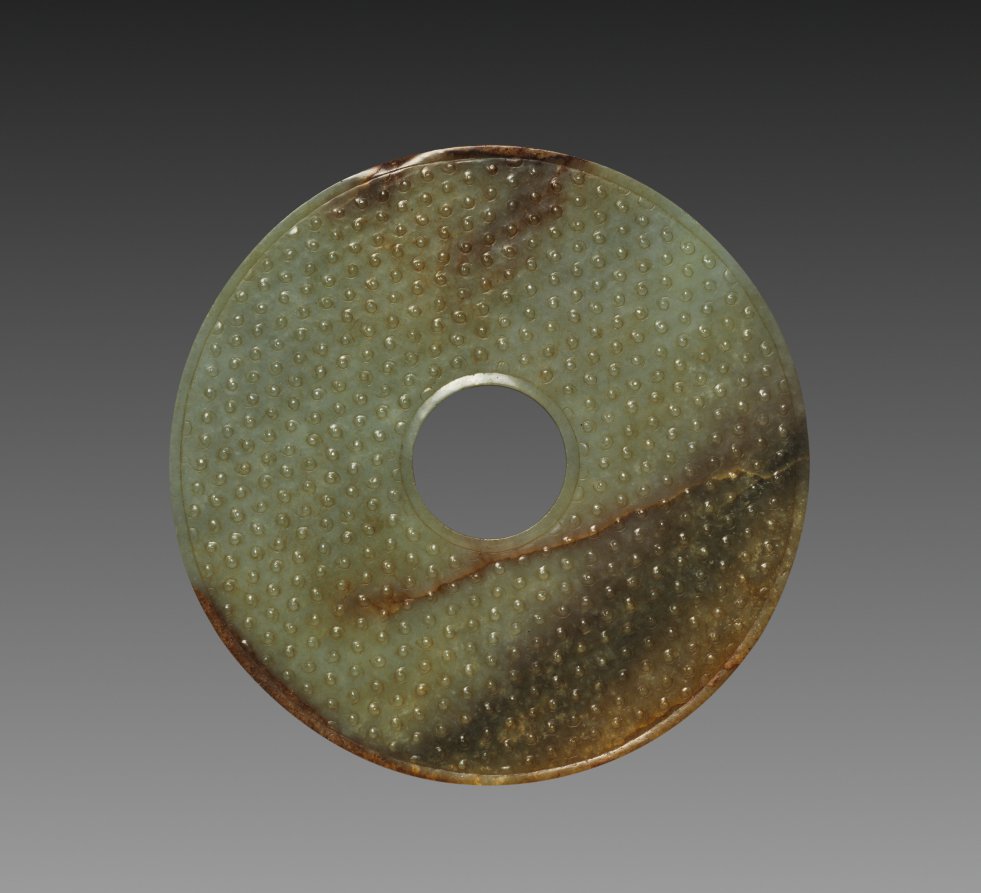
Ceremonial Disk with Grain Pattern (Bi) (475–221 BCE) is in the Cleveland Museum of Art collection.
The work and its context
The museum's open-access catalogue describes the work:
Jade disks of later centuries developed from the Neolithic period’s plain design to incorporate dense surface decoration. This example bears raised dots with finely incised spirals--so-called grain patterns--arranged in diagonal rows.
Object facts
- Title: Ceremonial Disk with Grain Pattern (Bi)
- Date: 475–221 BCE
- Culture: China, Warring States period (475–221 BCE)
- Type: Jade
- Technique: jade (nephrite)
- Dimensions: Diameter: 18.4 cm (7 1/4 in.)
- Collection: China - Zhou Dynasty
- Department: Chinese Art
- Accession number: 1952.567
A detail from the museum
The disk's outer rim is incised with a 47-character poem written in seal script, dated to the gengyin year of the Qianlong emperor's reign [1770].
Collection credit
Anonymous Gift
Further reading listed by the museum
- Lee, Sherman E. “Chinese Carved Jades.” The Bulletin of the Cleveland Museum of Art 41, no. 4 (April 1954): 67–68, 71.
View the collection record
See the museum's photographs and full catalogue entry. Catalogue text is reproduced from the Cleveland Museum of Art's open-access data, with HTML formatting removed. This object and its supplied image are designated CC0.
Sources
More in Lifestyle
Keep reading