St. John the Evangelist (c. 1700–1702): Art, History and Details
St. John the Evangelist at the Cleveland Museum of Art: c. 1700–1702, black, red, and white chalk. Explore the work's context, creator attribution and collection history.
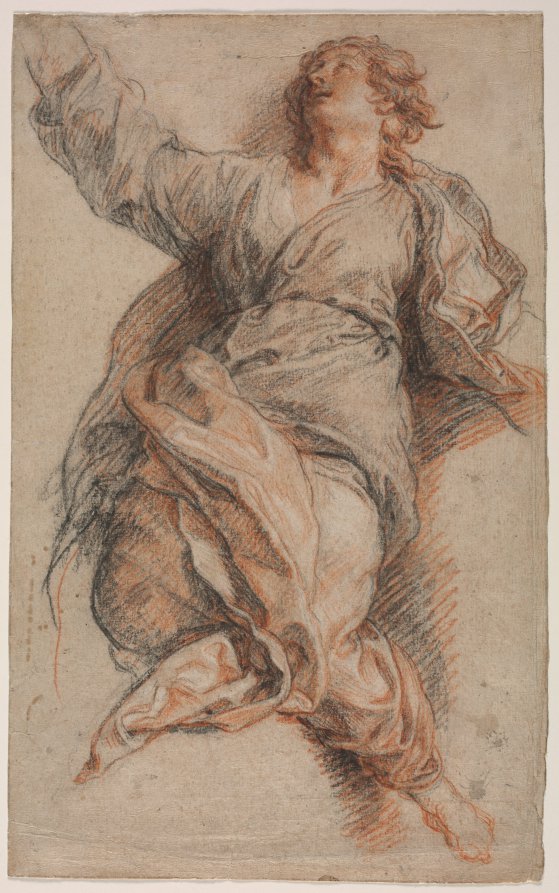
St. John the Evangelist (c. 1700–1702) is in the Cleveland Museum of Art collection. The museum's creator attribution is Charles de La Fosse (French, 1636–1716).
The work and its context
The museum's open-access catalogue describes the work:
This drawing is a study for a fresco in the Parisian church of Les Invalides. The structure's four pendentives are each decorated with images of the Four Evangelists, and the Cleveland sheet relates to the design for St. John. La Fosse developed his ideas in numerous preparatory studies before beginning the final painting. He portrayed the religious figures with power and exuberance, imbuing his decorative scheme with unprecedented vigor. Drawings by La Fosse are difficult to find in the United States, and this sheet is an exceptional example of the artist's trois crayons (three-chalk) technique of using black, red, and white chalk together. The chalks are subtly blended, creating the effect of billowing drapery rather than stiff linearity.
Object facts
- Title: St. John the Evangelist
- Date: c. 1700–1702
- Creator attribution: Charles de La Fosse (French, 1636–1716)
- Culture: France
- Type: Drawing
- Technique: black, red, and white chalk
- Dimensions: Sheet: 42 x 26.2 cm (16 9/16 x 10 5/16 in.)
- Collection: DR - French
- Department: Drawings
- Accession number: 1956.602
A detail from the museum
This drawing was used primarily used by La Fosse to study the drapery that covers St. John's body. A nude drawing of the same figure is in Le Havre, France.
Collection credit
Gift of Alida di Nardo in memory of her husband, Antonio di Nardo
Further reading listed by the museum
- Drawing Before 1800. Exh. Cat. Appleton, WI: Wooster Art Center at Lawrence University, 1968.
- Rosenberg, Pierre. French Master Drawings of the 17th & 18th Centuries in North American Collections. Translated by Catherine Johnston. Exh. Cat. Toronto: Art Gallery of Ontario, 1972.
- Rosenberg, Pierre. "Dessins français du XVIIe et du XVIIIe siècle dans les collections américaines." L'Oeil, nos. 212-213 (August-September 1972): 10-15.
View the collection record
See the museum's photographs and full catalogue entry. Catalogue text is reproduced from the Cleveland Museum of Art's open-access data, with HTML formatting removed. This object and its supplied image are designated CC0.
Sources
More in Lifestyle
Keep reading