Clasp Set with Semiprecious Stones (324–26 CE): Art, History and Details
Clasp Set with Semiprecious Stones at the Cleveland Museum of Art: 324–26 CE, gold and semiprecious stones. Explore the work's context, creator attribution and collection history.
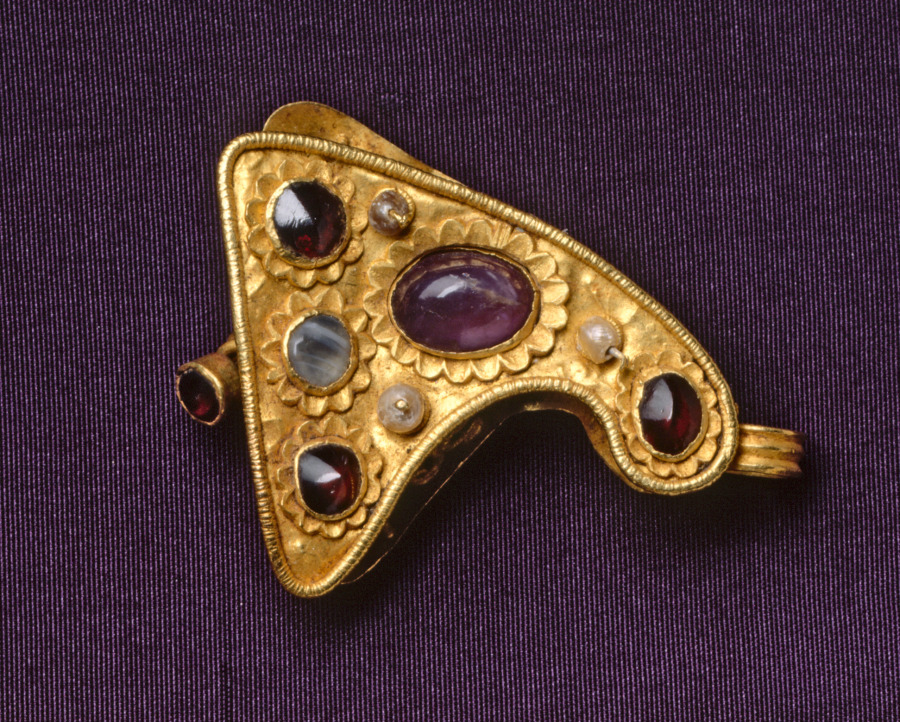
Clasp Set with Semiprecious Stones (324–26 CE) is in the Cleveland Museum of Art collection.
The work and its context
The museum's open-access catalogue describes the work:
Mounted at the center of this octagonal pendant is a rare coin issued by Constantine the Great, the Roman Empire’s first Christian emperor. Constantine’s portrait appears on the coin’s front, those of two of his sons on the back. Constantine’s image is surrounded by male and female busts, some of which are mythological figures. The pendant once formed the centerpiece of a sumptuous gold necklace, likely a gift for a high-ranking court official or member of the imperial family.
Object facts
- Title: Clasp Set with Semiprecious Stones
- Date: 324–26 CE
- Culture: Byzantium, Late Roman, Eastern Mediterranean, (probably Sirium or Nicomedia), Byzantine period
- Type: Jewelry
- Technique: gold and semiprecious stones
- Dimensions: Overall: 5 x 3.8 x 9.8 cm (1 15/16 x 1 1/2 x 3 7/8 in.)
- Collection: MED - Byzantine
- Department: Medieval Art
- Accession number: 1994.98.4
Collection credit
Leonard C. Hanna Jr. Fund
Further reading listed by the museum
- Deppert-Lippitz, Barbara. "Late Roman Splendor: Jewelry from the Age of Constantine." Cleveland Studies in the History of Art 1 (1996): 30-71.
View the collection record
See the museum's photographs and full catalogue entry. Catalogue text is reproduced from the Cleveland Museum of Art's open-access data, with HTML formatting removed. This object and its supplied image are designated CC0.
Sources
More in Lifestyle
Keep reading