Corinthian Helmet (c. 625–550 BCE): Art, History and Details
Corinthian Helmet at the Cleveland Museum of Art: c. 625–550 BCE, Bronze. Explore the work's context, creator attribution and collection history.
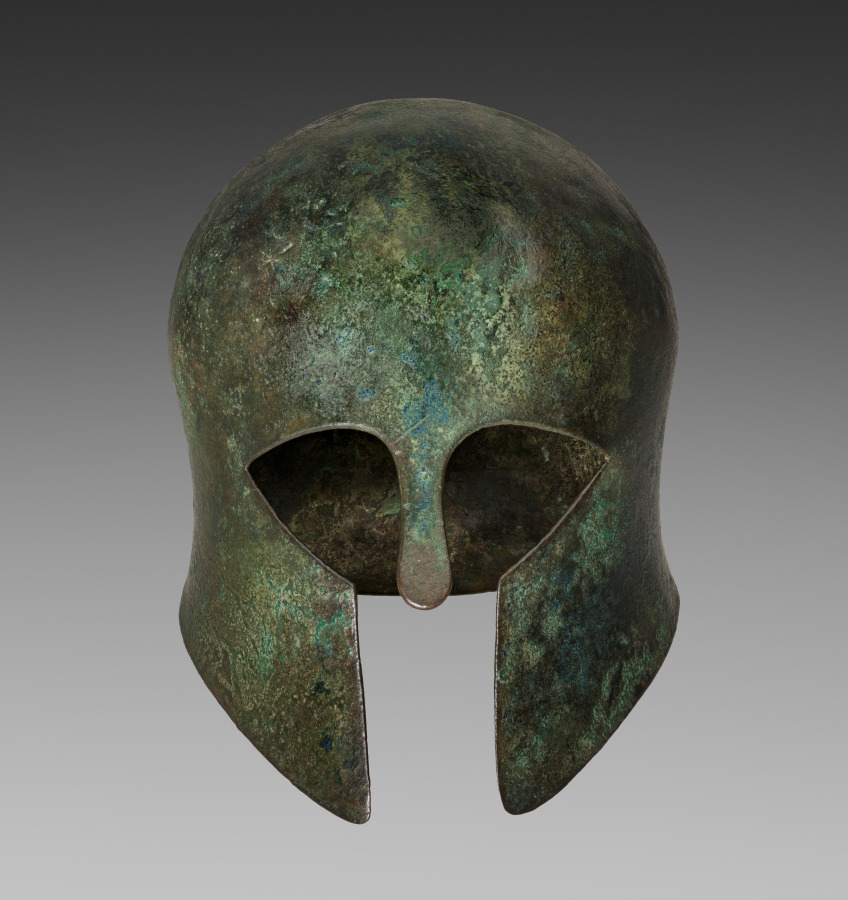
Corinthian Helmet (c. 625–550 BCE) is in the Cleveland Museum of Art collection.
The work and its context
The museum's open-access catalogue describes the work:
This remarkably well-preserved bronze helmet belongs to an iconic type known as Corinthian yet produced far beyond the city of Corinth. Designed for use by hoplite warriors, who fought with spears and shields in shoulder-to-shoulder (phalanx) formation, such helmets provide maximum protection but limited vision, hearing, and movement. Probably first cast and then hammered into its final shape, the helmet features both gentle curves and sharp angles, evoking the head and face that it protected. Similar helmets appear frequently on warriors shown in ancient art, though often with crests of horsehair or other organic materials that no longer survive.
Object facts
- Title: Corinthian Helmet
- Date: c. 625–550 BCE
- Culture: Greek
- Type: Arms and Armor
- Technique: Bronze
- Dimensions: Overall: 23.5 x 19.5 x 27 cm (9 1/4 x 7 11/16 x 10 5/8 in.)
- Collection: GR - Greek
- Department: Greek and Roman Art
- Accession number: 2024.63
A detail from the museum
A small hole above the rear neckline, now repaired, may reflect a fatal blow.
Collection credit
Leonard C. Hanna Jr. Fund
Further reading listed by the museum
- Kukahn, Erich. Der Griechische Helm. Marburg-Lahn, 1936. p. 70, no. 58.
- Kunze, Emile. Olympiabericht, Vol. VII. Berlin, 1961. p. 85, footnote no. 29.
- Hixenbaugh, R. and Waldman, A. Ancient Greek Helmets. New York, 2019. p. 376, cat. C269.
View the collection record
See the museum's photographs and full catalogue entry. Catalogue text is reproduced from the Cleveland Museum of Art's open-access data, with HTML formatting removed. This object and its supplied image are designated CC0.
Sources
More in Lifestyle
Keep reading