Dancing Dwarf (100 BCE–100 CE): Art, History and Details
Dancing Dwarf at the Cleveland Museum of Art: 100 BCE–100 CE, bronze. Explore the work's context, creator attribution and collection history.
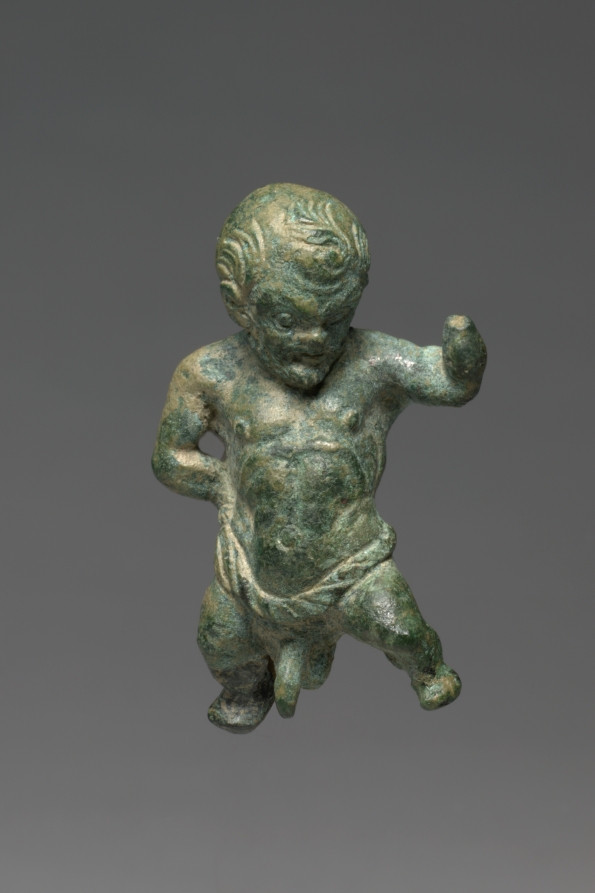
Dancing Dwarf (100 BCE–100 CE) is in the Cleveland Museum of Art collection.
The work and its context
The museum's open-access catalogue describes the work:
This small, bearded figure wears a twisted sash around his hips and has an exaggerated phallus. He stands with his left arm raised and his right arm on his waist. His left hand is missing but could have once held krotala (ancient clapper-like instruments), as other examples of dancing dwarves hold. People with dwarfism in art are typically rendered with a large head, widely spaced eyes, sharply raised eyebrows, and a depressed nasal bridge, all seen on this figure. This object may have been used as an apotropaic, or protective, amulet to ward off evil.
Object facts
- Title: Dancing Dwarf
- Date: 100 BCE–100 CE
- Culture: Italy(?), Roman
- Type: Sculpture
- Technique: bronze
- Dimensions: Overall: 4.4 cm (1 3/4 in.)
- Collection: GR - Roman
- Department: Greek and Roman Art
- Accession number: 1972.72
A detail from the museum
People with dwarfism were favorite subjects in Hellenistic art, and then became popular in the Roman Empire.
Collection credit
Sundry Purchase Fund by Exchange
Further reading listed by the museum
- Allentown Art Museum, Gloria Ferrari, and Brunilde Sismondo Ridgway. Aspects of Ancient Greece: An Exhibition Organized by the Allentown Art Museum with the Cooperation of Gloria Ferrari Pinney and Brunilde Sismondo Ridgway ... Allentown Art Museum, September 16 Through December 30, 1979. [Allentown, Pa.]: The Museum, 1979.
- Lee, Sherman E. “The Year in Review for 1972.” The Bulletin of the Cleveland Museum of Art 60, no. 3 (1973): 63–115.
- Masséglia, Jane. Body Language in Hellenistic Art and Society. First edition. Oxford: Oxford University Press, 2015.
View the collection record
See the museum's photographs and full catalogue entry. Catalogue text is reproduced from the Cleveland Museum of Art's open-access data, with HTML formatting removed. This object and its supplied image are designated CC0.
Sources
More in Lifestyle
Keep reading