Dancing Ganesha (c. 1000): Art, History and Details
Dancing Ganesha at the Cleveland Museum of Art: c. 1000, sandstone. Explore the work's context, creator attribution and collection history.
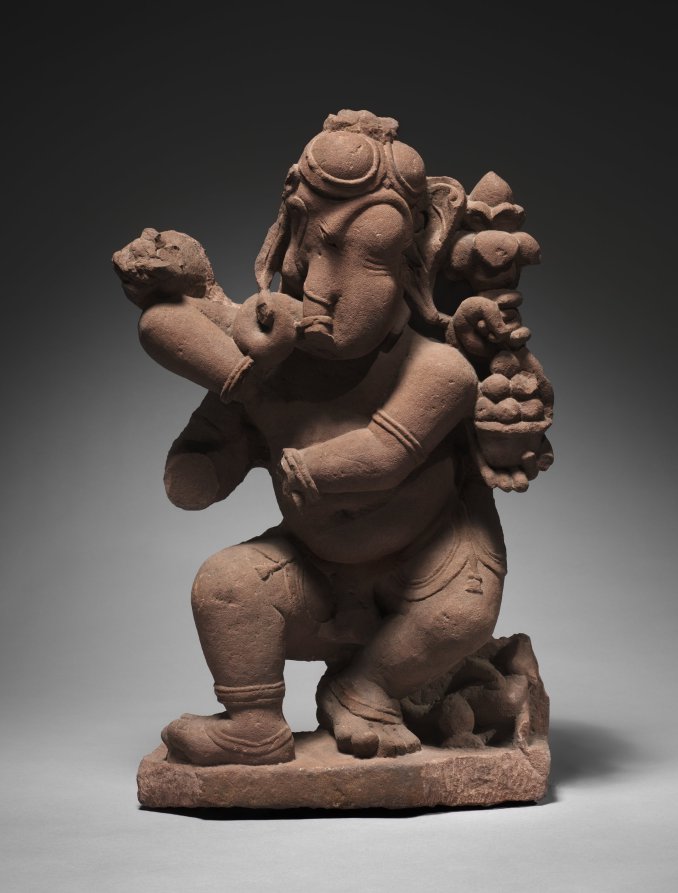
Dancing Ganesha (c. 1000) is in the Cleveland Museum of Art collection.
The work and its context
The museum's open-access catalogue describes the work:
The name Ganesha means "lord (isha) of the demonic dwarfs (gana)," part of Shiva's entourage. They dance and imitate Shiva in humorous ways that inspire his followers' affection. In this sculpture Ganesha's dance mimics the dance of Shiva. Ganesha has six arms instead of four, and he holds a bowl of sweet cakes and a radish instead of a tongue of flame.
Object facts
- Title: Dancing Ganesha
- Date: c. 1000
- Culture: Central India, Madhya Pradesh
- Type: Sculpture
- Technique: sandstone
- Dimensions: Overall: 61.3 cm (24 1/8 in.)
- Collection: Indian Art
- Department: Indian and Southeast Asian Art
- Accession number: 1961.93
A detail from the museum
Ganesha's mount is the rat, which evokes full granaries and the prosperity and abundance that they imply.
Collection credit
John L. Severance Fund
Further reading listed by the museum
- Lee, Sherman E. “Year in Review 1961.” The Bulletin of the Cleveland Museum of Art 48, no. 9 (1961): 219–251.
- The Cleveland Museum of Art. Handbook of the Cleveland Museum of Art/1966. Cleveland, OH: The Cleveland Museum of Art, 1966.
- The Cleveland Museum of Art. Handbook of the Cleveland Museum of Art/1969. Cleveland, OH: The Cleveland Museum of Art, 1969.
View the collection record
See the museum's photographs and full catalogue entry. Catalogue text is reproduced from the Cleveland Museum of Art's open-access data, with HTML formatting removed. This object and its supplied image are designated CC0.
Sources
More in Lifestyle
Keep reading