Dancing Satyr (500–475 BCE): Art, History and Details
Dancing Satyr at the Cleveland Museum of Art: 500–475 BCE, painted terracotta. Explore the work's context, creator attribution and collection history.
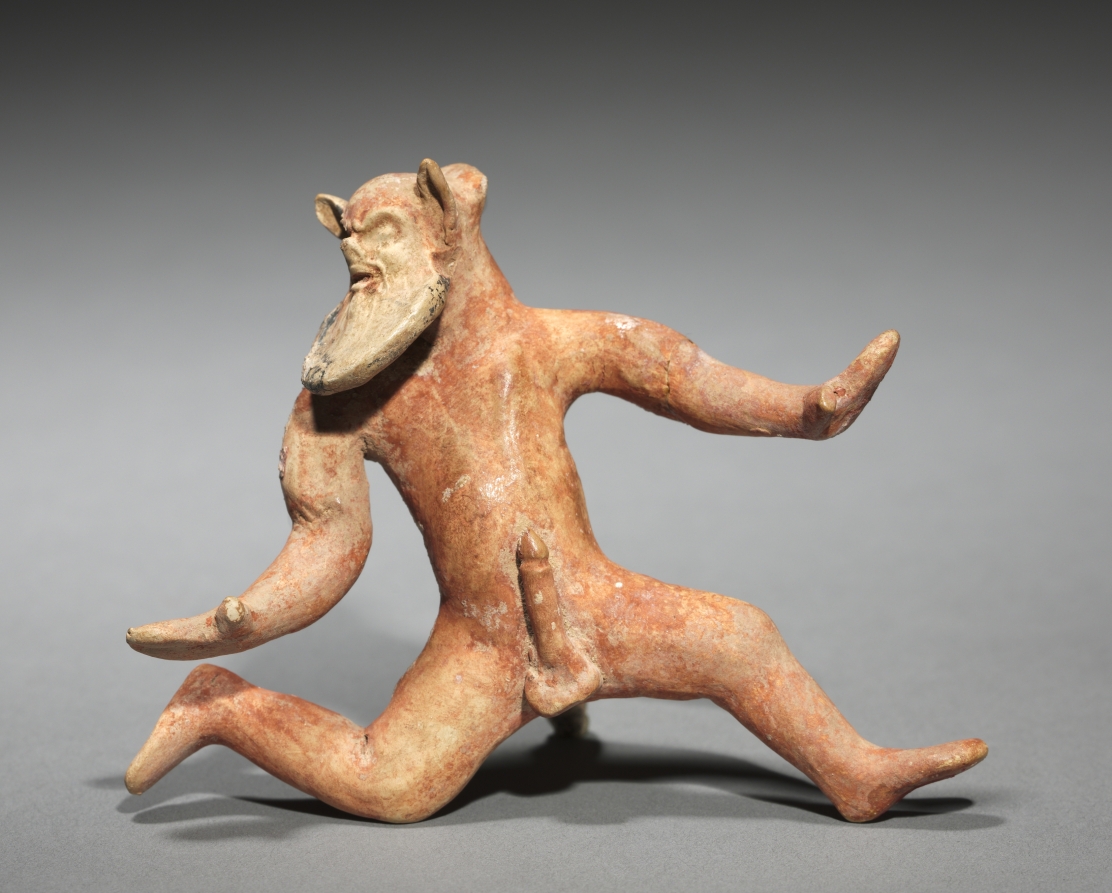
Dancing Satyr (500–475 BCE) is in the Cleveland Museum of Art collection.
The work and its context
The museum's open-access catalogue describes the work:
Part man and part beast, satyrs were mythical woodland creatures. In art, they were depicted with the ears and tail of a goat or horse, sometimes with hooves, and in a high state of sexual arousal. Satyrs often accompanied Dionysus, the god of wine, in his drinking bouts and other escapades. These three probably once decorated the rim of a large punch-bowl-shaped vessel for serving wine.
Object facts
- Title: Dancing Satyr
- Date: 500–475 BCE
- Culture: Greece, Boeotia
- Type: Sculpture
- Technique: painted terracotta
- Dimensions: Overall: 8.4 x 11 x 5.6 cm (3 5/16 x 4 5/16 x 2 3/16 in.)
- Collection: GR - Greek
- Department: Greek and Roman Art
- Accession number: 1992.352.1
Collection credit
John L. Severance Fund
Further reading listed by the museum
- Turner, Evan H. “The Year in Review for 1992.” The Bulletin of the Cleveland Museum of Art 80, no. 2 (February 1993): 38–79.
- Mikolic, Amanda. A Field Guide to Medieval Monsters. Cleveland: The Cleveland Museum of Art, 2019.
View the collection record
See the museum's photographs and full catalogue entry. Catalogue text is reproduced from the Cleveland Museum of Art's open-access data, with HTML formatting removed. This object and its supplied image are designated CC0.
Sources
More in Lifestyle
Keep reading
Related stories