Rustam meets the challenge of Ashkabus, from a Shah-nama (Book of Kings) of Firdausi (Persian, about 934–1020) (c. 1590–1600): Art, History and Details
Rustam meets the challenge of Ashkabus, from a Shah-nama (Book of Kings) of Firdausi (Persian, about 934–1020) at the Cleveland Museum of Art: c. 1590–1600, opaque watercolor and gold on paper. Explore the work's context, creator attributio
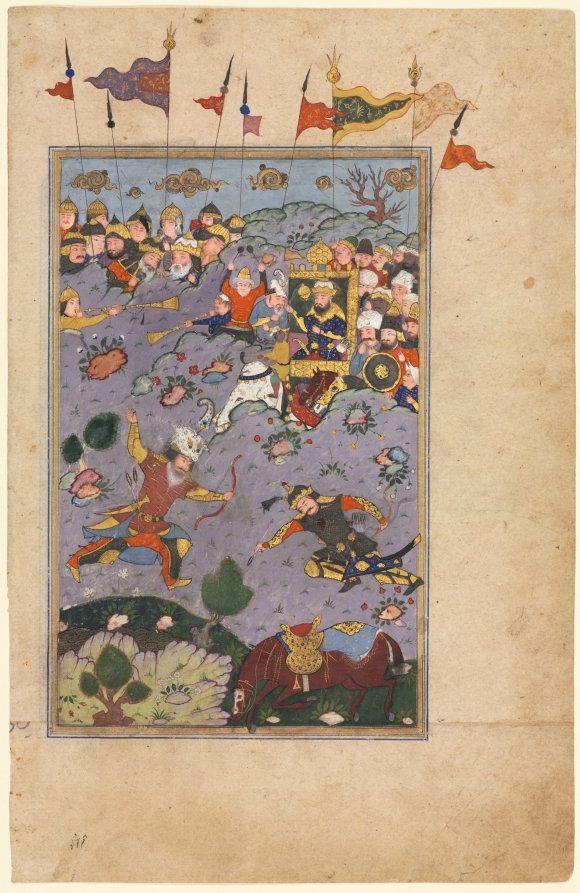
Rustam meets the challenge of Ashkabus, from a Shah-nama (Book of Kings) of Firdausi (Persian, about 934–1020) (c. 1590–1600) is in the Cleveland Museum of Art collection.
The work and its context
The museum's open-access catalogue describes the work:
Iran was losing a battle against Turan and the armies of its assembled allies from India and China. The hero Rustam arrived to pull the Iranian army back from the brink of destruction, slaying the enemy warrior Ashkabus on foot while allowing his horse Rakhsh to rest after a long, hard journey. The vast number of armies involved in the battle is indicated by the many banners that extend beyond the illustration’s top border. This painting was probably produced at Shiraz, one of Iran’s major cultural centers, far to the south of the Safavid capital of Tabriz. Artists and works of art moved back and forth steadily between Shiraz and the Deccan in southwestern India during the 1500s and 1600s. The section of the Shah-nama on the recto is famous for the clever conversational repartee between Rustam and his opponent Ashkabus. When Ashkabus remarked that in choosing not to ride a horse Rustam had signed his own death warrant, Rustam retorted, “Would it be the case then that in your country . . . lions, tigers, and crocodiles [all] ride on horses to battle?” Rustam then brought down the horse of Ashkabus with a single arrow; his next arrow pierced Ashkabus in the chest.
Object facts
- Title: Rustam meets the challenge of Ashkabus, from a Shah-nama (Book of Kings) of Firdausi (Persian, about 934–1020)
- Date: c. 1590–1600
- Culture: Iran, Shiraz, Safavid period (1501-1722)
- Type: Manuscript
- Technique: opaque watercolor and gold on paper
- Dimensions: Overall: 31 x 20.1 cm (12 3/16 x 7 15/16 in.); Text area: 25.4 x 15.7 cm (10 x 6 3/16 in.)
- Collection: Islamic Art
- Department: Islamic Art
- Accession number: 1960.199.b
A detail from the museum
The enemy ruler of China sits in a howdah on the back of a white elephant.
Collection credit
Gift of John C. Heege
Further reading listed by the museum
- The Cleveland Museum of Art. Handbook of the Cleveland Museum of Art/1966. Cleveland, OH: The Cleveland Museum of Art, 1966.
- The Cleveland Museum of Art. Handbook of the Cleveland Museum of Art/1969. Cleveland, OH: The Cleveland Museum of Art, 1969.
- The Cleveland Museum of Art. Handbook of the Cleveland Museum of Art/1978. Cleveland, OH: The Cleveland Museum of Art, 1978.
View the collection record
See the museum's photographs and full catalogue entry. Catalogue text is reproduced from the Cleveland Museum of Art's open-access data, with HTML formatting removed. This object and its supplied image are designated CC0.
Sources
More in Lifestyle
Keep reading