Dragon and Tiger (c. 1546–56): Art, History and Details
Dragon and Tiger at the Cleveland Museum of Art: c. 1546–56, One of a pair of six-panel folding screens; ink on paper. Explore the work's context, creator attribution and collection history.
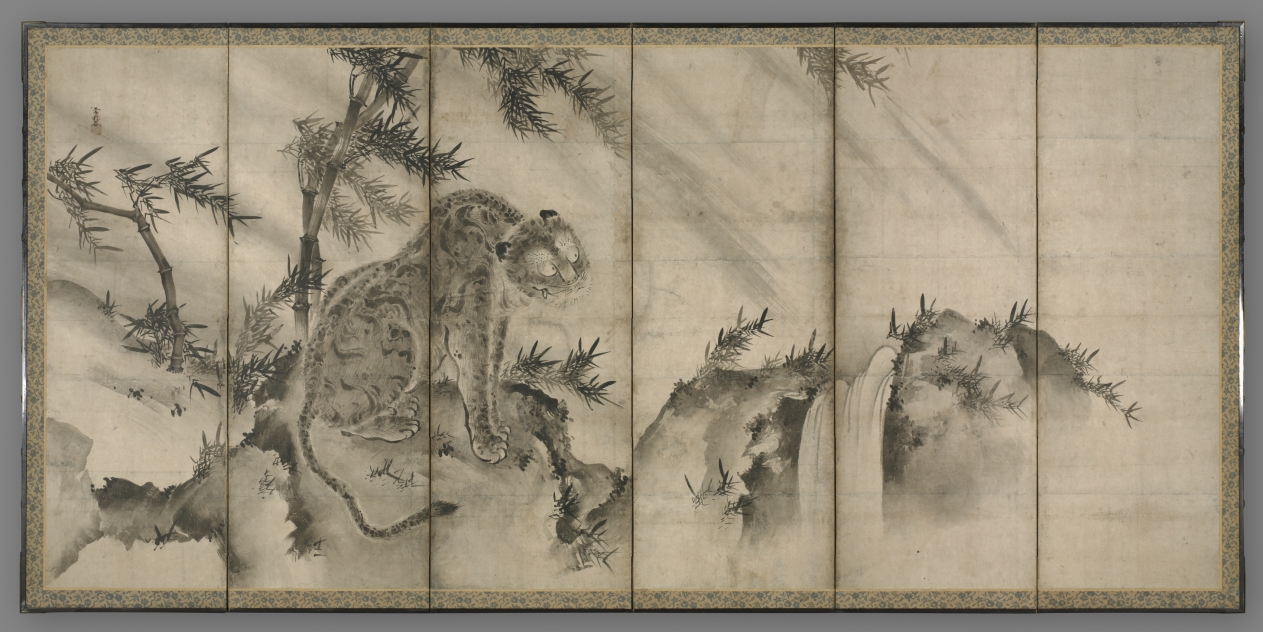
Dragon and Tiger (c. 1546–56) is in the Cleveland Museum of Art collection. The museum's creator attribution is Sesson Shūkei (Japanese, c. 1492–c. 1577).
The work and its context
The museum's open-access catalogue describes the work:
In Chinese cosmology, the tiger's roar is said to produce wind. In Chinese paintings, the tiger is often shown with a dragon, who creates rain clouds. Together, they represent the balancing forces of the universe. Chinese presentations of the theme, often in hanging scroll format, provided the basic composition for the pair of screens to which this one belongs.
Object facts
- Title: Dragon and Tiger
- Date: c. 1546–56
- Creator attribution: Sesson Shūkei (Japanese, c. 1492–c. 1577)
- Culture: Japan, Muromachi period (1392–1573) to Momoyama period (1573–1615)
- Type: Painting
- Technique: One of a pair of six-panel folding screens; ink on paper
- Dimensions: Painting: 157.3 x 339 cm (61 15/16 x 133 7/16 in.); Framed: 172.3 x 354 cm (67 13/16 x 139 3/8 in.)
- Collection: ASIAN - Folding screen
- Department: Japanese Art
- Accession number: 1959.136.2
A detail from the museum
Although the theme of this painting derives from Chinese philosophy and pictorial culture, Sesson's tiger is likely modeled after Korean prototypes of the Joseon period circulating in Japan.
Collection credit
Purchase from the J. H. Wade Fund
Further reading listed by the museum
- Japan, Commission imperiale a l'Exposition universelle de Paris, 1900. Kōhon Nihon Teikoku bijutsu ryakushi. Tōkyō: Nihon Bijutsusha, 1908.
- Lee, Sherman E. “The Tiger and Dragon Screens by Sesson.” The Bulletin of the Cleveland Museum of Art 47, no. 4 (April 1960): 64–69.
- Lee, Sherman E. Japanese Decorative Style. [Cleveland]: Cleveland Museum of Art, 1961.
View the collection record
See the museum's photographs and full catalogue entry. Catalogue text is reproduced from the Cleveland Museum of Art's open-access data, with HTML formatting removed. This object and its supplied image are designated CC0.
Sources
More in Lifestyle
Keep reading