Eccentric Flint (600–900): Art, History and Details
Eccentric Flint at the Cleveland Museum of Art: 600–900, chipped flint. Explore the work's context, creator attribution and collection history.
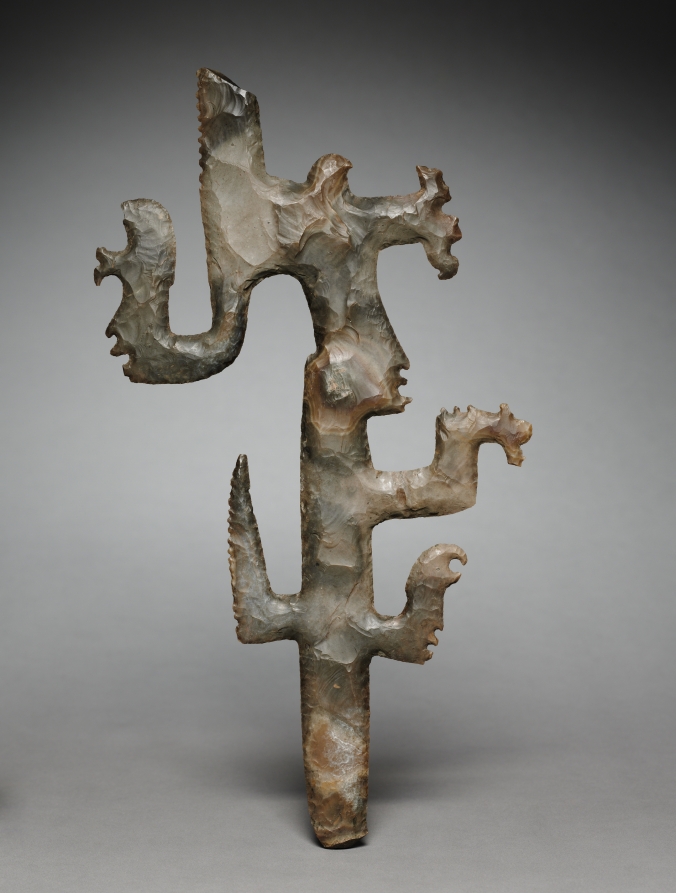
Eccentric Flint (600–900) is in the Cleveland Museum of Art collection.
The work and its context
The museum's open-access catalogue describes the work:
Named for their unusual shapes, eccentric flints often have intricately silhouetted figures like this. At the forehead of the main profile face is a smoking torch, the insignia of a deity closely linked to rulers and known today as K’awil. Smaller faces appear on three protrusions. Some flints may have served as scepters; they also were buried as offerings beneath buildings and sculptures.
Object facts
- Title: Eccentric Flint
- Date: 600–900
- Culture: Guatemala, Quirigua, Maya style (250-900)
- Type: Stone
- Technique: chipped flint
- Dimensions: Overall: 34.6 x 19.3 cm (13 5/8 x 7 5/8 in.)
- Collection: AA - Mesoamerica
- Department: Art of the Americas
- Accession number: 1950.161
Collection credit
John L. Severance Fund
Further reading listed by the museum
- Cleveland Museum of Art Picture Book
- Whitaker, Irwin. Crafts and Craftsmen. Dubuque, Iowa: W.C. Brown, 1967.
- International Congress of Americanists, Rudolf Grossmann, and Gustav Wilhelm Otto Antze. Verhandlung des XXIV. Internationalen amerikanistenkongresses, Hamburg, 7. bis 13. september 1930. Nendeln/Liechtenstein: Kraus Reprint, 1968.
View the collection record
See the museum's photographs and full catalogue entry. Catalogue text is reproduced from the Cleveland Museum of Art's open-access data, with HTML formatting removed. This object and its supplied image are designated CC0.
Sources
More in Lifestyle
Keep reading